
Direct Answer
The loop handle umbrella frame price can vary by several yuan—or close to RMB 10 per umbrella—even when two 23-inch × 10-rib automatic umbrellas look almost identical. The difference may come from rib material and thickness, shaft construction, the automatic opening-and-closing system, the handle, assembly tolerances, inspection standards, order quantity, and the supply-chain channel.
Before comparing quotations, overseas buyers should first align the finished size, frame structure, materials, mechanism, and acceptance standard. A product photo or a model name such as “23-inch × 10K C-handle umbrella” is not enough for an accurate comparison.
Case Scope and Information Boundaries
This Buyer Guide is based on a real overseas inquiry. The buyer sent a webpage reference image for a loop-handle automatic umbrella. The webpage stated an open diameter of 1.26 metres. After receiving and measuring the reference product, however, the buyer found that its actual diameter was below 1.26 metres.
The project remains at the inquiry, verification, and option-comparison stage. It has not become a confirmed order, sample-production project, or bulk-production project. The frame prices discussed below are part of the supplier quotations we encountered during this inquiry. They are time-sensitive reference data, not a unified market price.
Quick Facts
| Item | Verified information in this inquiry |
|---|---|
| Product type | Loop-handle / C-handle automatic umbrella |
| Online reference | The webpage image marked the open diameter as 1.26 m |
| Buyer measurement | The physical reference product measured less than 1.26 m |
| Regular reference option | 23-inch × 10 ribs, approximately 1.06 m open diameter in the frame being discussed |
| Larger option | To approach 1.26 m, a frame around 27-inch × 10 ribs may need to be considered |
| Recent partial frame quotations | More than RMB 60 to nearly RMB 200 per dozen for some 23-inch × 10-rib loop-handle frames |
| Quotation unit | 1 dozen = 12 umbrella frames |
| Project status | Inquiry, measurement verification, and solution comparison only |
Important: inch labels and finished canopy diameters are not fixed universal equivalents. Final dimensions must be confirmed using the selected frame, a physical sample, and an agreed measurement method.
Customer Reference Image and Size Question
The buyer wanted a product with the general appearance of a loop-handle automatic umbrella. This style is often called a loop handle umbrella or C handle umbrella in overseas enquiries. The names are useful search terms, but they do not define the internal mechanism, material grade, or finished size.
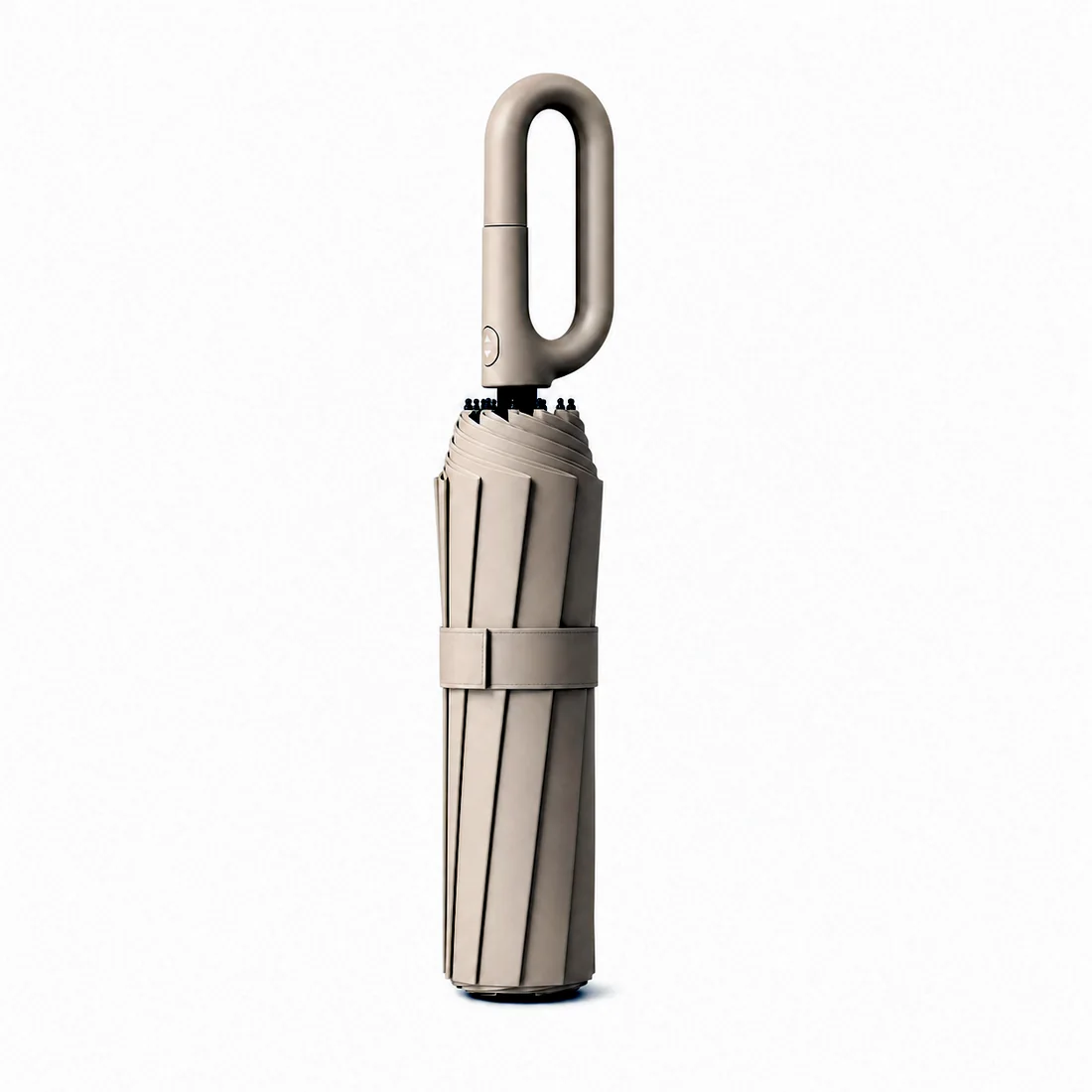
The key question was not simply whether we could make an umbrella that looked similar. We first had to determine whether the buyer needed the common visual style shown in the reference, or a finished umbrella that truly opened to approximately 1.26 metres.
Actual Measurement Result
After receiving a physical reference product, the buyer measured it and confirmed that its open diameter was below the 1.26-metre figure shown online. Based on the frame appearance and the measurement discussion, the common 23-inch × 10-rib option—approximately 1.06 metres for the reference frame—was closer to the product type shown.
This verification matters. If a factory quotes and samples against an inaccurate online dimension, the result may cause:
- a quotation based on the wrong frame size;
- a sample that does not match the buyer’s written requirement;
- changes to fabric consumption, packaging, and shipping dimensions;
- additional international sample delivery time and cost; or
- acceptance problems if the umbrella is for a tender, campaign, or contract with a stated size.
Why Online Umbrella Dimensions May Be Inaccurate
Many online listings are written for retail shoppers rather than professional sourcing teams. The dimensions may have been copied from another seller, measured with a different method, rounded for marketing, or confused with arc size, rib length, or canopy width.
Even when two suppliers use the same “23-inch” description, finished dimensions can vary because of rib curvature, tip-to-tip measurement, canopy tension, shaft and runner position, and the exact frame design. For sourcing purposes, a listing image should therefore be treated as a visual reference—not as a production specification.
Two Possible Size Solutions
Option 1: A Regular 23-Inch × 10-Rib Loop-Handle Umbrella
This is one of the more common reference configurations for this style. In this inquiry, the expected open diameter was approximately 1.06 metres. It may be the appropriate solution when the buyer mainly wants the appearance and user experience of the reference umbrella.
The 1.06-metre figure is not a universal industry guarantee. The final size still depends on the actual frame and the measurement method agreed by both parties.
Option 2: A Larger Solution Approaching 1.26 Metres
If the buyer’s contract or project specification genuinely requires an open diameter close to 1.26 metres, a regular 23-inch × 10-rib frame should not be assumed to meet it. A larger structure—such as a frame around 27-inch × 10 ribs—may need to be evaluated.
The larger option should be confirmed through a physical sample, including open diameter, weight, folded length, handle size, stability, and automatic opening-and-closing performance. The correct choice depends on whether the buyer needs the reference appearance or the written 1.26-metre dimension.
Why Frame Prices Differ
During recent frame enquiries and purchasing discussions, some 23-inch × 10-rib loop-handle automatic frames were quoted at more than RMB 60 per dozen, while other quotations approached RMB 200 per dozen. One dozen means 12 frames.
Some supplier quotations encountered around Jinjiang, Fujian were in the RMB 60, RMB 70, RMB 80, or above RMB 90 per dozen ranges. Some quotations from suppliers around Huizhou and Shenzhen, Guangdong reached RMB 136, RMB 180, or close to RMB 200 per dozen. These regional examples cannot be compared without matching the configuration, and they should not be treated as current standard prices for either region.
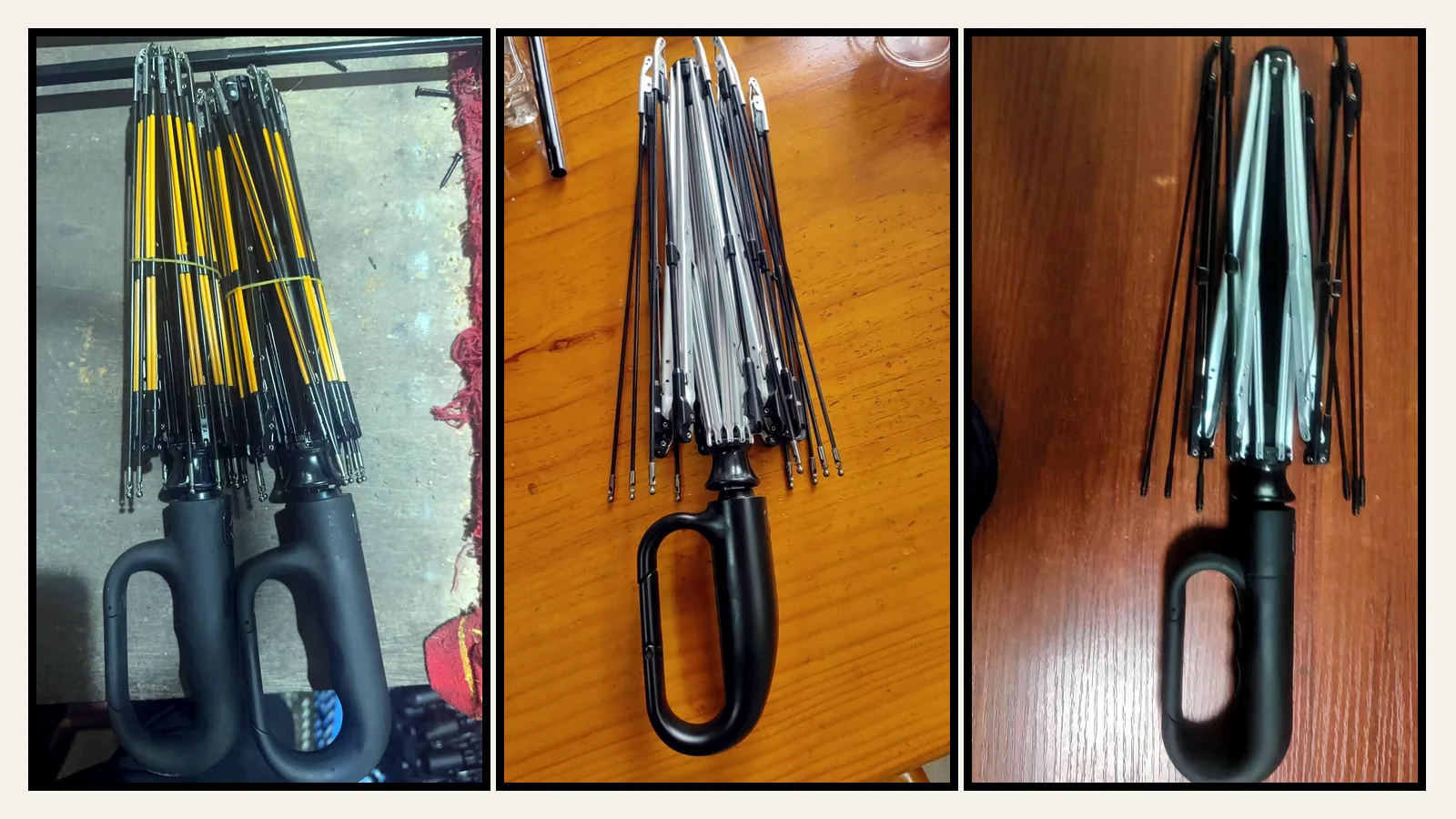
1. Rib Materials and Thickness
Steel, aluminium alloy, fibreglass, and mixed constructions differ in cost, weight, and load behaviour. Even within the same material name, diameter, wall thickness, coating, and processing quality can vary.
2. Shaft Construction
Automatic umbrellas usually use a multi-section shaft. Tube material, diameter, wall thickness, surface finish, connection accuracy, and sliding tolerance affect both cost and operating stability.
3. Automatic Opening-and-Closing System
Springs, cords, pulleys, locking points, and other internal components determine opening force, closing feel, reliability, and service life. A quotation that only says “automatic frame” does not identify these details.
4. Loop Handle and Connection Method
Handle material, mould quality, surface treatment, and the joint between the handle and shaft can create meaningful cost differences.
5. Assembly Tolerances
Two sets of similar-looking components may perform differently after assembly. Alignment, riveting, joint clearance, and runner movement affect consistency and labour requirements.
6. Inspection and Acceptance Standards
Sampling frequency, opening-and-closing checks, cosmetic inspection, dimensional tolerance, and defect-handling rules all add cost. A lower quotation may simply include a different inspection scope.
7. Quantity and Supply-Chain Channel
Small trial quantities, existing stock, special components, factory-direct purchases, and distributor sourcing can produce different unit costs.
8. Supplier Region and Management Model
Different umbrella clusters have different labour costs, component networks, specialities, order thresholds, and management structures. Region alone does not prove quality.
Cost Calculation
Assume that two suppliers quote RMB 80 and RMB 180 per dozen for what appears to be the same umbrella frame:
RMB 100 ÷ 12 ≈ RMB 8.3 per frame
The frame alone therefore creates an average difference of about RMB 8.3 per finished umbrella. The final umbrella price also includes fabric, printing, sewing, handle work, packaging, inspection, and management. This is why two finished-umbrella quotations may differ by several yuan even when their photos look similar.
The calculation explains the arithmetic only. It does not prove that either frame is the better purchasing choice.
Specification Comparison Checklist
| Specification to confirm | Questions for the supplier | Why it affects price or risk |
|---|---|---|
| Finished open diameter | What is the actual measured diameter, and how is it measured? | Prevents confusion between online claims, rib size, arc size, and finished diameter |
| Frame size and rib count | Is it 23-inch × 10 ribs, 27-inch × 10 ribs, or another configuration? | Changes fabric use, weight, folded size, and frame cost |
| Rib material and dimensions | Steel, aluminium, fibreglass, or a combination? What thickness? | Affects cost, weight, flexibility, and strength |
| Shaft structure | How many sections, what material, and what tube dimensions? | Affects operating stability and durability |
| Automatic mechanism | Automatic open only, or automatic open and close? Which mechanism? | Internal parts and assembly complexity vary |
| Handle | What material, mould, finish, and attachment method are used? | Appearance alone may hide different construction |
| Surface treatment | What coating or plating is applied to exposed components? | Affects appearance, corrosion resistance, and cost |
| Inspection standard | Which dimensions, functions, and appearance items are checked? | Different acceptance standards produce different quotations |
| Order quantity | Is the quote for a trial order, normal MOQ, or bulk order? | Small-quantity and stock conditions affect cost |
| Sample basis | Will the approved sample become the bulk-production reference? | Creates a shared, testable acceptance standard |
Supplier and Regional Differences
Umbrella production uses a network of frame makers, handle suppliers, fabric suppliers, printers, sewing teams, assemblers, and packaging partners. A custom umbrella manufacturer may coordinate these specialists rather than making every component in one building.
That network can be an advantage when it is managed well, but it also means that quotation sources matter. One supplier may quote an existing stock frame, another a made-to-order configuration, and another a frame sourced through an intermediary. The best choice is the configuration that meets the buyer’s intended use and acceptance standard—not automatically the cheapest or most expensive offer.
Lessons for Overseas Buyers
- Verify the finished size first. Ask for an actual measurement, not only the inch label.
- Agree on the measurement method. Define tip-to-tip diameter or another method in writing.
- Separate appearance from specification. A reference photo shows style, not internal construction.
- Request a component-level quotation. Identify frame, fabric, printing, handle, packaging, and inspection assumptions.
- Compare like with like. Match rib material, shaft, mechanism, handle, quantity, and acceptance criteria.
- Use a physical sample. Record the approved sample as the reference for bulk production.
- Do not treat one price range as the whole market. Supplier conditions and material costs change.
- Plan for resampling risk. Clear specifications reduce international courier cost and delay.
A practical sourcing sequence is: verify size → define structure and materials → agree on measurement and inspection → make or approve a sample → compare written quotations.
For more sourcing references, see our umbrella categories and Buyer Guides. If you need two size options evaluated against one reference product, you can also contact our team.
FAQ
Is a loop handle umbrella the same as a C handle umbrella?
The two terms are often used for the same general handle shape in international enquiries. They do not define the frame material, automatic mechanism, or finished size, so the complete specification still needs to be confirmed.
What does 23-inch mean on an umbrella frame?
It is mainly a frame-size reference related to the rib, not a guaranteed finished canopy diameter. Rib curvature, frame design, and measurement method can change the final dimension.
What is the open diameter of a 23-inch × 10-rib loop-handle umbrella?
For the regular reference frame discussed in this inquiry, the approximate open diameter was 1.06 metres. This is not a universal value; confirm it using the actual frame and an agreed measurement method.
Which frame should be considered for an umbrella close to 1.26 metres?
A larger structure, such as a frame around 27-inch × 10 ribs, may need to be evaluated. The finished diameter, weight, folded length, handle, and automatic operation should all be checked with a physical sample.
Why can similar loop-handle umbrella frames differ by nearly RMB 10 each?
A difference of RMB 100 per dozen equals about RMB 8.3 per frame. Materials, shaft construction, automatic mechanism, handle, assembly, inspection, quantity, and sourcing channel can widen or reduce the difference.
Does a higher frame price always mean a more durable umbrella?
No. Price alone does not prove durability. Buyers should compare the documented configuration, sample performance, inspection scope, and suitability for the intended use.
Can a supplier quote accurately from a product image?
An image can support an initial budget estimate, but it cannot confirm the internal structure or actual dimensions. A final quotation should be based on written specifications, an actual reference, or an approved sample.
How can an overseas buyer avoid repeated umbrella samples?
Confirm the required open diameter, measurement method, frame structure, materials, mechanism, handle, and intended use before sampling. When the online image and written size conflict, compare two technical options first.
Conclusion
The main lesson from this inquiry is simple: define the umbrella before comparing the price. Similar-looking loop-handle umbrellas may use very different frames, and even the size shown in an online listing may not match the physical product.
For this case, a regular 23-inch × 10-rib frame and a larger solution approaching 1.26 metres represented two different purchasing requirements. The correct specification must be confirmed before sampling or bulk production. The project is still under evaluation, and no order or production result is claimed in this guide.