Direct answer: A magnetic adjustable umbrella holder combines a conventional straight-shaft umbrella, an articulated support arm and a magnetic base to provide temporary shade over a work area without someone holding the umbrella. It may be suitable for air-conditioning maintenance, vehicle repairs, stationary machinery maintenance and outdoor workbenches when a suitable magnetically responsive steel mounting surface is available. Compatibility must be checked as a complete assembly: the mounting surface, shaft clamp, arm position, canopy size, umbrella weight and wind conditions all matter. A base that attracts to a surface does not, by itself, establish that the installation is stable or suitable for the intended work.
By Hand in Hand Umbrella Factory
Scope: an application guide, not a tested safety rating
This guide explains how a straight umbrella and an adjustable magnetic holder can be evaluated for temporary shading. The applications described are potential uses, not documented customer installations or completed performance tests.
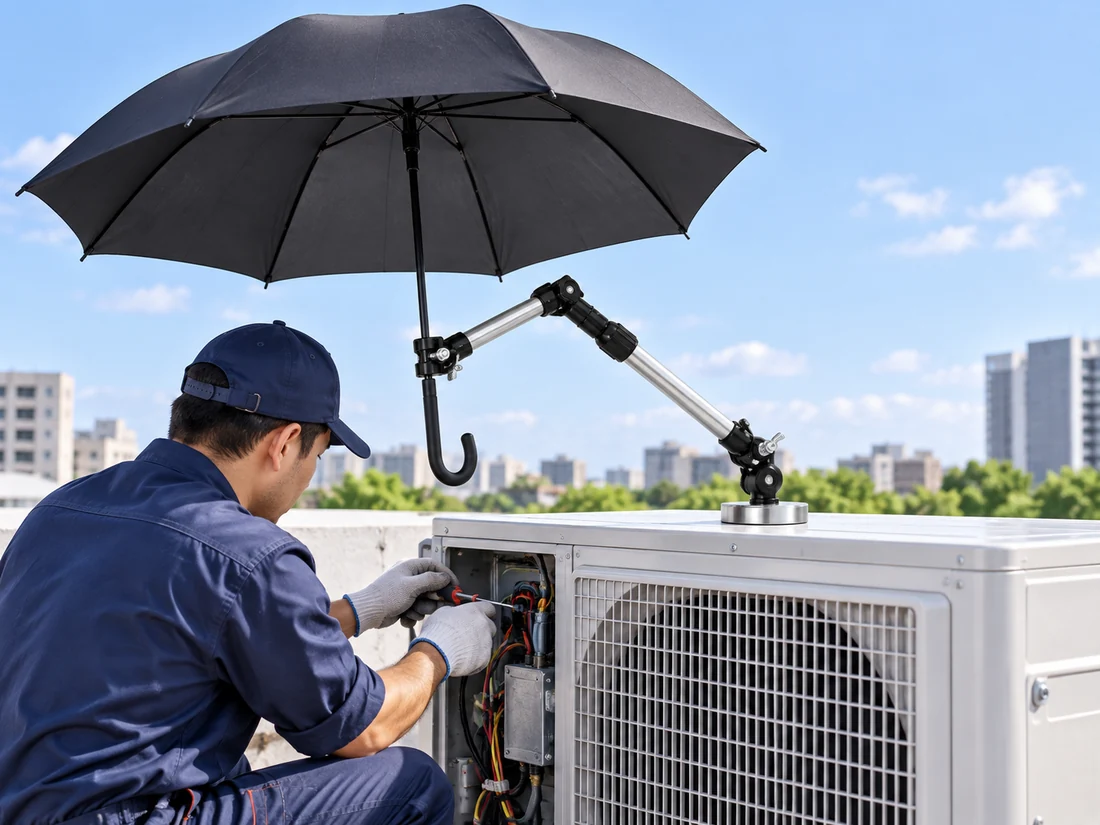
The supplied application illustration and holder display image explain the concept and visible construction. They do not establish load capacity, magnetic holding force, wind resistance or electrical safety. Exact materials, dimensions, shaft-clamping range and operating limits must be confirmed for the specific product and installation.
What problem does the holder solve during outdoor repairs?
Outdoor technicians often need both hands for tools and components. Holding an umbrella at the same time is inconvenient, while a freestanding parasol requires floor space and a place for its base. Some working positions offer neither.
An adjustable magnetic holder offers another approach: attach the base to a suitable steel surface near the working position and adjust the umbrella so that its canopy shades the required area.
Air-conditioning maintenance illustrates the idea. A potentially suitable mounting location might be a steel support frame or an outdoor unit’s steel top panel. However, the panel must first be confirmed as magnetically responsive and suitable for the loads imposed by the complete holder-and-umbrella assembly. The installation must not obstruct equipment ventilation, access or the technician’s work.
The purchasing question is therefore not simply whether an umbrella is available. Buyers need to establish:
- Can it be secured at a suitable location at the site?
- Can the canopy reach the area that needs shade?
- Will the chosen position interfere with the task?
- Is the complete assembly stable under the intended conditions?
How does a straight umbrella work with an adjustable magnetic arm?
The arrangement has three main elements. Each has a separate role, but they need to be selected together.
1. The straight umbrella provides the shaded area
Canopy size and umbrella weight should match the application and the holder. A larger canopy is not automatically a better choice: it also makes the effect of wind more important to assess.
The umbrella does not need to be an entirely new type of product. The change is primarily in how a compatible straight-shaft umbrella is supported and positioned.
2. The adjustable arm positions the umbrella
The arm’s joints allow the position and angle of the umbrella shaft to change relative to the mounting base. The available adjustment range and locking method depend on the actual holder design.
A useful position must shade the working area without blocking access, restricting tool movement or interfering with equipment.
3. The magnetic base connects to the mounting surface
The base uses magnetic attraction to attach to a suitable steel or iron surface. Unlike a freestanding parasol, it does not require a separate floor-standing base.
However, magnetic attachment is conditional on the material and surface being suitable. It is not a universal mounting method for every piece of equipment.
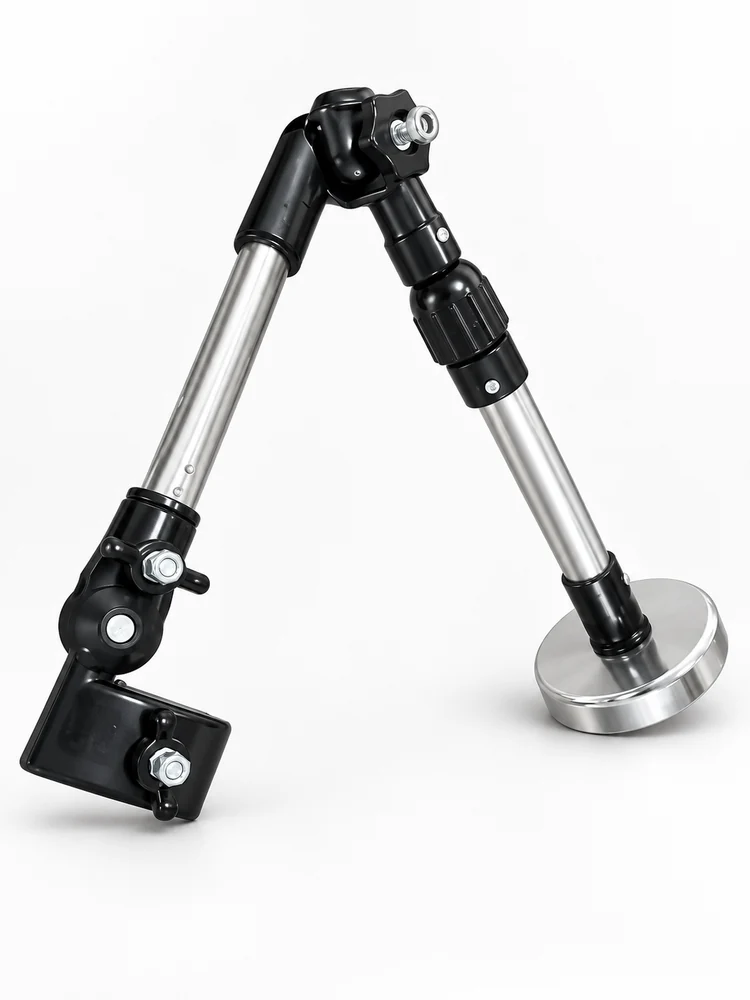
The umbrella provides shade, the holder positions it, and the stability of the combined assembly is what must be verified.
Which outdoor work applications are worth evaluating?
The following are possible applications to assess. They do not mean that every vehicle, machine or workbench has a suitable mounting location.
| Application | Mounting position to evaluate | Main purpose and checks |
|---|---|---|
| Air-conditioning installation and maintenance | A suitable steel outdoor-unit top panel or nearby steel frame | Shade the service area; confirm panel strength, ventilation clearance and service access. |
| Vehicle repairs | A steel tool trolley or fixed work stand | Shade the repair area without interfering with maintenance or equipment movement. |
| Construction-machinery maintenance | A suitable steel surface on securely parked, stopped equipment | Shade a maintenance position only while equipment is stationary and shut down; not for moving or operating machinery. |
| Outdoor workbenches | A stable steel workbench or support frame | Provide temporary shade for assembly, inspection and equipment adjustment. |
| Mobile vending or equipment carts | A suitable steel body on a securely parked cart | Shade a local work surface or monitor while the cart remains stable and stationary. |
An application illustration can make the purpose easy to understand: where the umbrella attaches, what it covers and why nobody needs to hold it. It cannot replace installation checks or turn an unverified use into a customer case study.
Why will a magnetic umbrella holder not attach to every metal surface?
A magnetic base is not effective on every metal. Aluminium, copper, plastic and some stainless steels must not be assumed to be suitable mounting materials.
Even when a steel surface attracts the magnet, further checks are necessary:
- Contact: Is the surface sufficiently flat for the base to make proper contact?
- Panel strength: Is the steel too thin or prone to deformation?
- Surface condition: Are coverings or structural features preventing close contact?
- Arm extension: Could the assembly slide or tip when the arm is extended?
- Overall suitability: Are the umbrella and operating environment within the intended limits?
Vehicle body panels require particular attention because materials and curvature vary between vehicles and between different parts of the same vehicle. Paint protection also needs consideration.
The correct description is “for confirmed suitable magnetically responsive steel or iron surfaces,” not “for all metal surfaces.”
Why should buyers confirm the umbrella and holder as one system?
Checking the magnet on its own is not enough. When the arm extends and the canopy opens, the loading at the mounting position differs from that of a base simply resting on a surface. Wind acting on the canopy also transfers forces through the shaft and arm to the mounting position.
Use the following specification checklist when comparing a holder-and-umbrella combination.
| Check | What needs to be confirmed |
|---|---|
| Shaft-to-clamp fit | Shaft diameter, clamping position and the condition of the shaft after tightening. |
| Canopy and weight | Whether the umbrella’s size and weight suit the holder and intended application. |
| Arm position and joints | Whether the arm reaches the shaded area, locks appropriately and leaves access clear. |
| Base and mounting surface | Surface material, shape, contact, panel strength and actual installation suitability. |
| Operating and storage limits | Permitted installation orientation, environmental conditions and requirements for closing, removing and storing the assembly. |
A magnetic holding-force figure alone does not establish the stability of an extended arm carrying an open umbrella.
Without confirmed specifications and relevant verification, buyers should not rely on an unqualified pull-force claim, an unsupported wind rating or a promise that the umbrella will “never fall off.”
Is a magnetic umbrella holder protective equipment?
This arrangement is a temporary shading tool. It must not be presented as professional safety equipment.
Near electrical equipment, an umbrella does not replace the equipment’s specified weather protection, insulation or required work precautions. Putting a canopy above a repair position does not make an otherwise unsuitable wet-weather electrical task safe.
This arrangement should not be treated as a dependable strong-wind shelter. Keep the arrangement away from open flames, high temperatures and flying sparks. A maintenance application does not mean it is suitable above welding work or hot equipment.
If wind becomes noticeable, the canopy starts moving significantly or the attachment becomes unstable, stop using the arrangement and close the umbrella.
What should buyers prepare before requesting a quotation?
Start with the site conditions, then select the umbrella and support together. Useful information includes:
- The task and site photographs: Describe the work and show where shade is needed.
- The proposed mounting surface: Provide its material, shape and approximate dimensions.
- The area to be shaded: Identify the working position rather than asking only for the largest possible canopy.
- The umbrella or shaft details: Provide the shaft size of an existing umbrella, or the type of umbrella you plan to purchase.
- Quantity and branding requirements: Specify order quantity, colours and logo-printing needs.
- Handling and operating conditions: Explain storage, transport and the environment in which the assembly will be used.
Confirming these conditions first is more useful than asking for a set price without a defined installation or compatible umbrella.
For related procurement preparation, see our custom umbrella buying guides. You can also contact Hand in Hand Umbrella Factory with site photographs and umbrella requirements.
Frequently asked questions
Can I buy only the holder for a straight umbrella I already own?
An existing umbrella can be assessed, but not every straight umbrella will fit. Confirm the shaft diameter, clamping position, umbrella weight and the holder’s permitted operating conditions before treating the combination as compatible.
Can the magnetic base attach to any car body?
No. Different vehicles and body sections can use different materials, and curved panels or unsuitable positions may prevent proper mounting. Check material and surface conditions first, and consider protection of the painted finish.
Does a stronger magnet always make the umbrella safer?
No. Stability also depends on base contact, arm extension, joint locking, umbrella size and weight, and operating conditions. The complete assembly needs evaluation; magnetic holding force alone is not enough.
Can I use this umbrella arrangement in strong wind?
It should not be treated as a reliable shelter for strong-wind conditions. Stop using it and close the umbrella when wind becomes noticeable, the canopy moves significantly or the mounting becomes unstable. No specific wind-resistance rating is claimed in this guide.
Can the umbrella carry our company logo and colours?
Logo, colour, quantity and application requirements can be submitted for assessment. Feasibility then depends on the compatible umbrella style, materials and printing method; branding does not remove the need to verify the umbrella-and-holder combination.
Conclusion: choose the mounting solution around the actual task
A magnetic adjustable holder changes how a conventional straight umbrella is supported. Under suitable conditions, it can create a temporary shaded working position without someone holding the umbrella.
The decisive purchasing checks are whether the site provides a suitable mounting surface, whether the umbrella and holder fit each other, whether the canopy can be positioned usefully, and whether the operating limits are clear.
Hand in Hand Umbrella Factory welcomes enquiries with actual site information, umbrella specifications and quantity requirements so that compatibility can be discussed before a product or custom-printing arrangement is selected.