
SUPPLIER VISIT & COMPONENT QUALITY
How Are High-Quality Wooden Umbrella Handles Made? 12 Production Steps from Cutting to Painting
What I learned after driving more than 200 kilometres and following production for several days at a wooden-handle supplier.
Direct Answer: How Are Wooden Umbrella Handles Made?
A high-quality wooden umbrella handle is not simply shaped and painted. In the production process I observed, the work involved cutting timber into blanks, trimming each blank to length, lathe turning, drilling the shaft hole, repairing natural surface defects, fine sanding, applying primer, polishing again after the primer dried, applying two separate topcoats, fitting connectors or wrist cords, and completing a final inspection. The result depends not only on the timber, but also on dimensional accuracy, surface preparation, the number of coating stages, drying time and assembly control. Skipping any of these stages may reduce cost and lead time, but it can also change the colour, smoothness, finish consistency and fit of the handle.
What Are the 12 Main Production Steps?
- Cut the timber into long, workable strips.
- Trim the strips into individual handle blanks.
- Turn each blank on a lathe to create the required profile.
- Drill the internal hole for the umbrella shaft or connector.
- Inspect and repair natural surface defects where necessary.
- Sand the surface carefully to remove tool marks and burrs.
- Apply primer to prepare and seal the surface.
- Allow the primer to dry under the supplier’s controlled process.
- Polish the primed handle again by hand.
- Apply the first topcoat and allow it to reach the required condition.
- Apply the second topcoat for fuller colour and a more consistent finish.
- Fit connectors or cords and inspect the finished component.
Why Did I Spend Several Days at the Supplier?
Normally, an umbrella factory confirms the wooden-handle specification with a specialist supplier, waits for the components to be completed and then receives them for final umbrella assembly. This order did not follow the expected schedule. The supplier had moved its factory, and production fell more than ten days behind the original plan.
During this follow-up, we also heard that relocation, fire-safety inspections and concentrated order schedules were affecting some related suppliers. These were circumstances encountered in this particular supply chain; they do not describe the entire wooden umbrella handle industry.
Specialist wooden-handle suppliers are less common than ordinary plastic-component suppliers. When capacity becomes tight, a delay at one upstream factory can affect the assembly schedule for the complete umbrellas. I initially expected that a single visit would be enough. After seeing that each coating and drying stage genuinely required time, I stayed for several days and followed our order through the workshop.
How Does a Wooden Handle Move from Timber to a Finished Component?
1–2. Cutting Timber and Preparing Individual Blanks
The process begins with timber or partly processed wood. The supplier cuts it into long square strips and then trims those strips into individual blanks of the required length. This first stage already needs to anticipate the final shape and connection method.
Wooden handles for straight umbrellas and folding umbrellas are not interchangeable. Diameter, length and profile can differ, while the shape may be cylindrical, tapered, curved or specially designed. If the blank dimensions are not suitable, later turning and assembly become harder to control.
3. Lathe Turning: Forming the Basic Handle Shape
Each square blank is turned on a woodworking lathe until the required profile appears. Round, tapered and curved sections are created at this stage. Consistent turning affects not only appearance, but also later sanding, coating and the dimensional fit of the assembled umbrella.
4. Drilling: Preparing the Connection to the Umbrella Shaft
After shaping, the supplier drills the hole that receives the umbrella shaft or a connecting component. Hole diameter, depth and centre alignment must match the actual frame structure. An inaccurate hole can cause looseness, visible misalignment or assembly failure. For buyers, this means that internal dimensions are just as important as the visible surface.
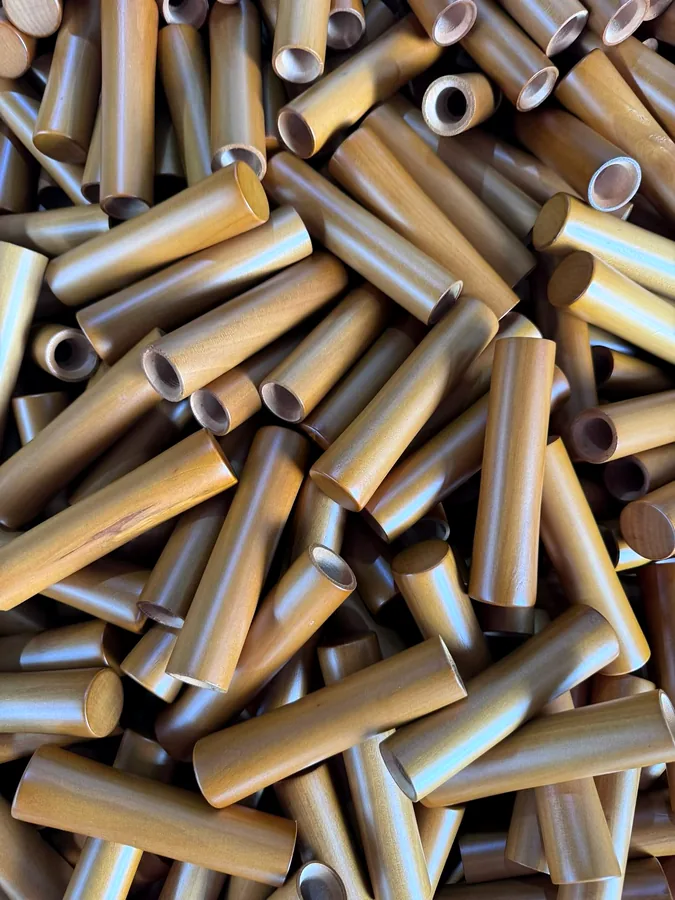
5–6. Repairing Natural Defects and Fine Sanding
Wood is a natural material. Grain variation, small holes, shallow depressions and other surface characteristics may appear after turning. At the supplier I visited, workers checked the shaped handles before painting. Where a small defect could affect the final coating, they repaired the area with an appropriate filler and levelled the surface.
Fine sanding then removed lathe marks, burrs and uneven areas. Defects that look minor on bare wood can become more visible after coating. This is why sanding is not a cosmetic extra: it strongly influences how smooth the handle feels and how even the painted surface looks.
7–9. Primer, Drying and a Second Manual Polish
The handles were hung on a track system and moved into the coating area for primer. After application, the primer needed time to dry. One of the most important details I observed was what happened next: workers removed the handles and polished them again by hand.
A dried primer surface may still contain fine particles or slightly rough areas. Applying the topcoat immediately would preserve those defects. Re-polishing creates a smoother base, but it adds labour, handling and production time.
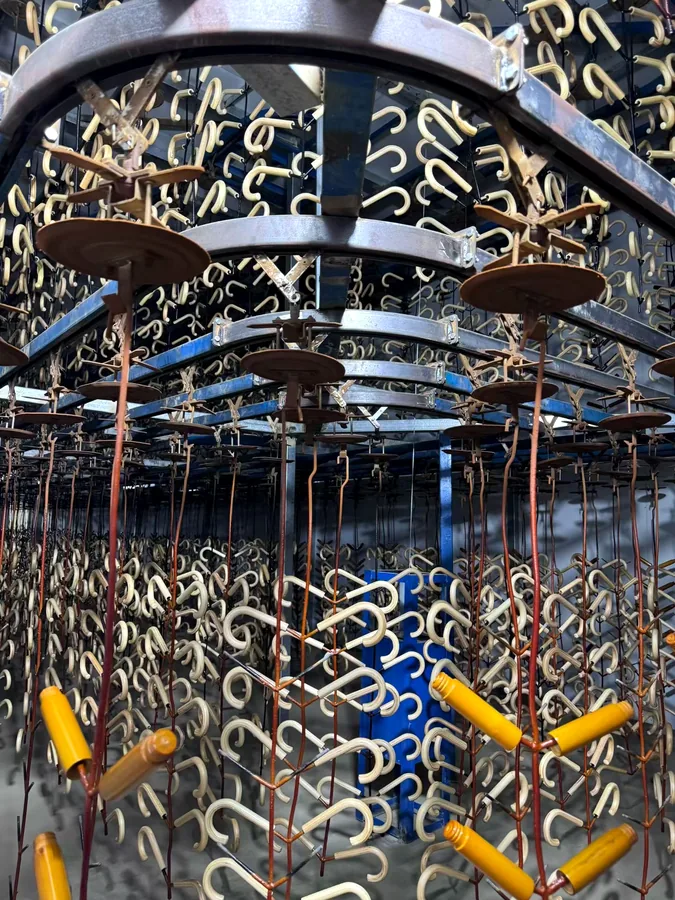
10–11. Why Were Two Topcoats Applied?
After the primed handles were polished again, they returned to the coating line. The supplier applied one topcoat, waited for the coating to reach the appropriate condition and then applied a second topcoat. In this process, the second application helped produce fuller colour, a more even surface and a more refined overall feel.
The difference is not merely “one more spray.” Additional coating stages increase paint consumption, manual handling, polishing work, drying time and production-management requirements. Lower-cost processes may reduce some of these steps, but buyers should then evaluate the resulting finish rather than assuming that all painted wooden handles are equivalent.
12. Final Assembly and Inspection
Depending on the design, a completed wooden handle may still require a plastic connector, a wrist cord or another attachment before it can be installed on an umbrella frame. The finished component should then be checked for surface condition, colour consistency, hole position, dimensions and suitability for assembly.
Was the Wood Species Confirmed?
No. During the visit, a workshop employee described the material as being similar to birch and suitable in density for turning and finishing. However, the supplier did not provide formal species documentation. We therefore do not list birch—or any other named species—as a confirmed technical parameter for this batch.
Wood species can matter, but it is not the only quality factor. Selection, turning accuracy, defect repair, sanding, primer, polishing and topcoat control all influence the finished result. When species verification is important to a buyer, it should be written into the specification and supported by agreed documentation before production.
Why Do Wooden Umbrella Handle Quality, Price and Lead Time Differ?
| Factor | What buyers should compare | Possible effect |
|---|---|---|
| Blank preparation | Dimensions, allowance for turning and visible material condition | Shape consistency and material use |
| Lathe turning | Profile accuracy and dimensional consistency | Appearance, sanding work and assembly fit |
| Drilling | Hole diameter, depth and centre alignment | Shaft fit, straightness and assembly stability |
| Defect repair | Whether visible holes and depressions are treated before coating | Surface uniformity after painting |
| Sanding | Level of manual finishing before primer | Smoothness and visibility of tool marks |
| Primer process | Whether primer is used and allowed to dry adequately | Base quality and finish consistency |
| Polishing after primer | Whether fine roughness is removed before topcoating | Final tactile and visual finish |
| Topcoats | Number of applications and drying intervals | Colour fullness, gloss and production time |
| Supply schedule | Supplier capacity, relocation or inspection disruptions, and order concentration | Component lead time and umbrella assembly schedule |
A higher price does not automatically prove better quality. The useful comparison is whether quotations cover the same dimensions, drilling, repair, sanding, primer, polishing, topcoats, attachments, inspection standard and delivery commitment.
Why Should a Custom Umbrella Manufacturer Understand Its Upstream Handle Supplier?
Many overseas buyers imagine that one umbrella factory produces every component inside a single building. In practice, fabrics, frames, wooden handles, plastic parts, printing and packaging may come from different specialist suppliers.
The manufacturer’s responsibility is not limited to final assembly. It must understand which supplier suits the product, which stages affect quality, which costs can be adjusted safely, how to respond to an upstream delay and when changing suppliers would create more risk than waiting. Visiting the source of a delayed component gave us better evidence for making those decisions and for explaining the trade-off between finish, cost and schedule to buyers.
How Much Lead Time Should Buyers Allow?
There is no universal lead time for wooden handles. A project with demanding colour, shape and surface-finish requirements should normally allow more component time than a standard plastic-handle project. Turning, defect repair, sanding, primer drying, re-polishing and multiple topcoats cannot always be compressed without affecting the result.
Buyers should confirm the handle process early, approve colour and surface expectations, and leave contingency time before final umbrella assembly. A realistic time allowance improves supply-chain resilience and makes the expected finish easier to achieve.
Frequently Asked Questions
1. Are wooden umbrella handles made from one standard wood species?
No. Species and grades vary by design, supplier, availability and buyer requirements. If the species matters, request written confirmation and any required supporting documentation. The species used in the order described here was not formally verified.
2. Why is primer important on a painted wooden handle?
Primer prepares the surface for the topcoat and can help create a more consistent base. In the observed process, the supplier also polished the dried primer before topcoating to remove fine roughness. The exact coating system should be agreed for each project.
3. Does a wooden handle with two topcoats always have better quality?
Not automatically. The final result also depends on preparation, paint compatibility, application control and drying. Two topcoats improved fullness and consistency in the process observed here, but buyers should assess an approved sample rather than judge only by the number of coats.
4. Why can wooden umbrella handles delay a custom umbrella order?
Wooden handles require several specialist machining, surface-preparation, coating and drying stages. Supplier capacity, relocation, inspections and concentrated orders can also affect scheduling. Because final umbrella assembly may depend on these components, buyers should build contingency time into the project plan.
5. What should an overseas buyer confirm before ordering wooden handles?
Confirm the shape and dimensions, shaft-hole diameter and depth, connection method, colour reference, acceptable natural variation, repair and sanding expectations, coating sequence, attachments, sample approval method, inspection criteria and component lead time.
Conclusion
A refined wooden umbrella handle is produced through a chain of ordinary but demanding operations. The quality comes from completing those operations consistently rather than relying on the words “natural wood.” Our supplier visit showed why turning, drilling, repair, sanding, primer, polishing, repeated painting, drying and assembly all matter—and why a custom umbrella project must budget both money and time for the finish it expects.