In a development discussion with a Japanese customer, we considered a sun-and-rain umbrella combining lower closing effort, a tidier canopy and a finished-weight target of no more than 350 g. That combination requires coordinated sampling of the frame, fabric, coating and folding process—not simply adding a feature name to a quotation.
This case describes one customer’s requirements and our proposed evaluation approach. It is not evidence that all Japanese buyers have the same preferences, and the targets below are not verified finished-product specifications. For a broader process introduction, see our memory umbrella folding technology guide.
Easy-close vs. memory-fold: which problem are you solving?
Buyers sometimes use “easy to close” to describe several different actions. Before choosing a frame or fabric treatment, separate them:
| Action | Relevant feature | What the buyer should check |
|---|---|---|
| Open or collapse the canopy and frame | Automatic open-and-close mechanism | Button operation, opening and closing behavior, and instructions for the actual model. |
| Push the telescopic shaft back into its storage position | Easy-close or lower-effort shaft-reset structure | Required force, travel and handling on a complete sample. Confirm any staged locking or anti-rebound function separately. |
| Arrange the canopy, wrap the strap and put it into its sleeve | Memory-fold or folding-assist canopy treatment | How closely the fabric follows its creases and how much manual arrangement remains. |
In this discussion, “easy-close” referred to the shaft-reset effort. The Chinese term sometimes used in conversation, “jie-jie shou,” should not be treated as a standardized specification. Ask the supplier to demonstrate the exact mechanism. Do not assume that it includes anti-rebound protection.
As an external product example, MOONBAT’s URAWAZA automatic umbrella page describes button operation and canopy folding assistance separately. Its product features are not test results or certifications for our proposed umbrella.
What did the Japanese customer want to develop?
- Finished weight: a target of 350 g or less, with the weighing scope still to be agreed—for example, whether the sleeve and accessories are included.
- Canopy: proposed 30D pongee fabric with a light-blocking treatment, subject to finished-sample evaluation.
- Light blocking: a zero-light-transmission target requiring an agreed test method, specimen and supporting report before any performance claim.
- Closing experience: easier manual shaft compression plus a canopy that is quicker to arrange.
Why does 30D fabric not guarantee a lightweight finished umbrella?
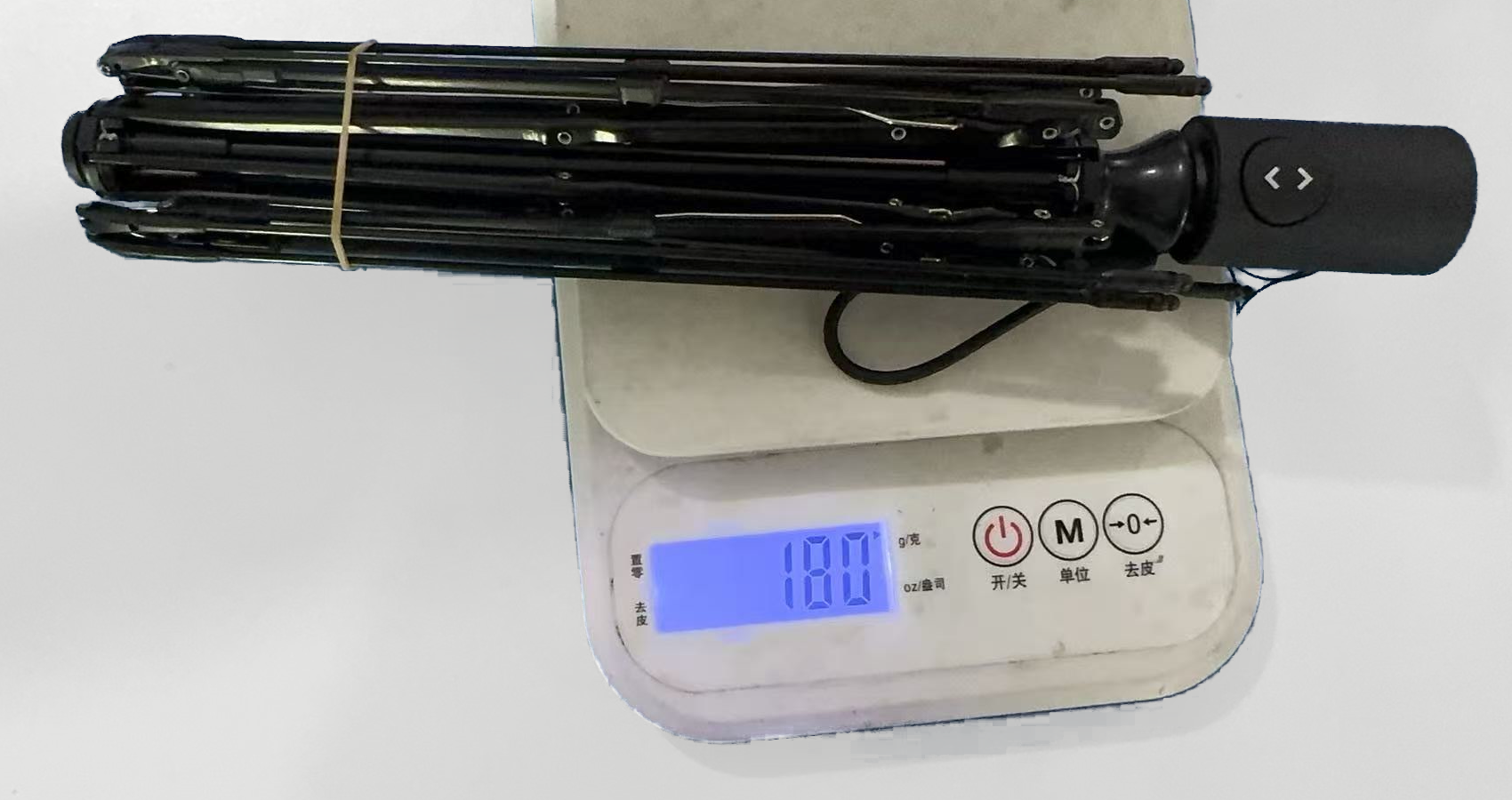
A fabric designation is only one part of the specification. The frame, shaft, handle, canopy dimensions, coating, shaping materials, strap and other accessories all contribute to the final mass. We would weigh each complete proposed configuration under the same conditions, rather than use a bare-frame photo as proof.
Why must light blocking and UV protection be confirmed separately?
Visible-light transmission and ultraviolet protection describe different properties. A light-blocking target is not a substitute for an appropriate UV test, and neither establishes a UPF rating without supporting evidence. Agree which performance is required, what is tested and which report applies to the supplied fabric or finished product. Rain-use requirements also need their own checks.
Two memory-fold routes considered for sampling
The two options below were proposed comparison routes, not an exhaustive classification of all umbrella folding technologies.
| Route | Working approach | Checks before approval |
|---|---|---|
| Patch- or film-assisted shaping | Shaping patches or composite film placed on selected inner-canopy areas help guide the fabric into folds. | Placement, bonding stability, appearance, feel, finished weight, packed volume and behavior after repeated opening and closing. |
| Heat-set fabric folds | A material-compatible forming process sets folds into suitable fabric so the canopy more readily follows those creases. | Fabric and coating compatibility, crease retention, appearance and repeat-cycle behavior on the complete sample. |
Neither route is automatically lighter, more durable or less expensive. Compare equivalent canopy sizes, frames, coatings and accessories. A process that works well on one fabric should not be assumed to work equally well on another.
AMVEL’s explanation of its shape-memory fabric provides an external example of a material-specific heat-forming approach. We do not claim its proprietary technology, materials or published performance as our own.
What does “three-second folding” actually include?
A timing claim is only useful when the start and finish points are defined. Is the clock started before pressing the button, after the canopy collapses, or after the shaft is compressed? Does the finish include arranging fabric, fastening the strap and inserting the umbrella into a sleeve?
For a meaningful comparison, also specify dry or wet condition, permitted manual adjustment, operator procedure and repeated trials. This case has not established a three-second folding result. A brief demonstration should not replace a written sample acceptance procedure.
Six checks to agree before approving the sample
- Finished weight and scope. Weigh the actual agreed configuration and state whether the sleeve and accessories are included.
- Shaft-reset effort. Compare the compression action using a consistent method. Record force measurements if a numerical force requirement is part of the brief.
- Canopy tidying. Record the full sequence and the manual steps needed, not just button-operated closing.
- Light-blocking and UV evidence. Agree separate requirements and applicable test methods. Do not carry over an unrelated fabric report to a different specification.
- Repeated use and basic quality. Agree the cycle count and conditions; inspect crease retention, patch adhesion where relevant, appearance and mechanism operation. Include the rain-performance and other quality checks needed for the intended product.
- Cost and delivery scope. Confirm sample charges, revision scope, process costs and production lead time for the actual configuration. This article does not provide a fixed price or guaranteed delivery schedule.
Frequently asked questions
Are easy-close and memory-fold umbrellas the same?
No. Easy-close concerns shaft-reset effort in this case; memory-fold concerns canopy arrangement. A product may combine them, but each feature needs separate verification.
Does automatic open-and-close mean the shaft is easy to compress?
No. The button-operated canopy action and manual shaft compression are different steps. Test the return effort on the exact model.
Which memory-fold route is lighter?
There is no universal answer. Compare complete samples with equivalent dimensions, frames, coatings and accessories.
Can 30D fabric guarantee a finished weight under 350 g?
No. In this project, 350 g is a development target, not a verified result. The complete configuration must be weighed.
Does the scale photograph show the finished umbrella’s weight?
No. It shows a frame and handle without the canopy. It is a component reference only.
Does a zero-light-transmission target prove UV protection?
No. Light blocking and UV protection need separately defined requirements and appropriate evidence. No UV rating is established by this case.
Planning a custom sun-and-rain umbrella?
Send your target market, umbrella type, quantity, preferred size, weight target and light-blocking or UV requirements. Tell us whether your priority is lower shaft-reset effort, easier canopy tidying or both, so we can discuss a suitable sampling plan.
Contact our umbrella development team · Explore umbrella products
Browse all buyer guides · Related: memory-fold processes and buyer checks