
By Aihua Chen | Hand in Hand Umbrella Factory
Direct Answer: How Should a Bespoke Umbrella Handle Be Developed?
Develop a bespoke umbrella handle in stages: use a prototype to confirm its size, grip and fit on the umbrella, then validate the proposed material and connection before choosing a production process. For a planned batch of 100–200 handles per design, silicone-mold casting is one option worth evaluating against injection molding. Compare the total cost for each design, including tooling, replacement molds, finishing and assembly—not just the quoted unit price. A good-looking prototype is not proof of durability, and the most suitable process depends on the drawings, material requirements, quantities and expected repeat orders.
Case Scope: An Australian Inquiry, Not a Completed Production Case
An Australian customer approached us about developing an umbrella for his own brand. He wanted his chosen colorful canopy artwork and a handle made to his own distinctive design rather than an off-the-shelf component.
This guide explains our preliminary development assessment and supplier cost discussions. It does not report completed sample testing, an approved production material or finished bulk production. The customer’s confidential design is not shown.
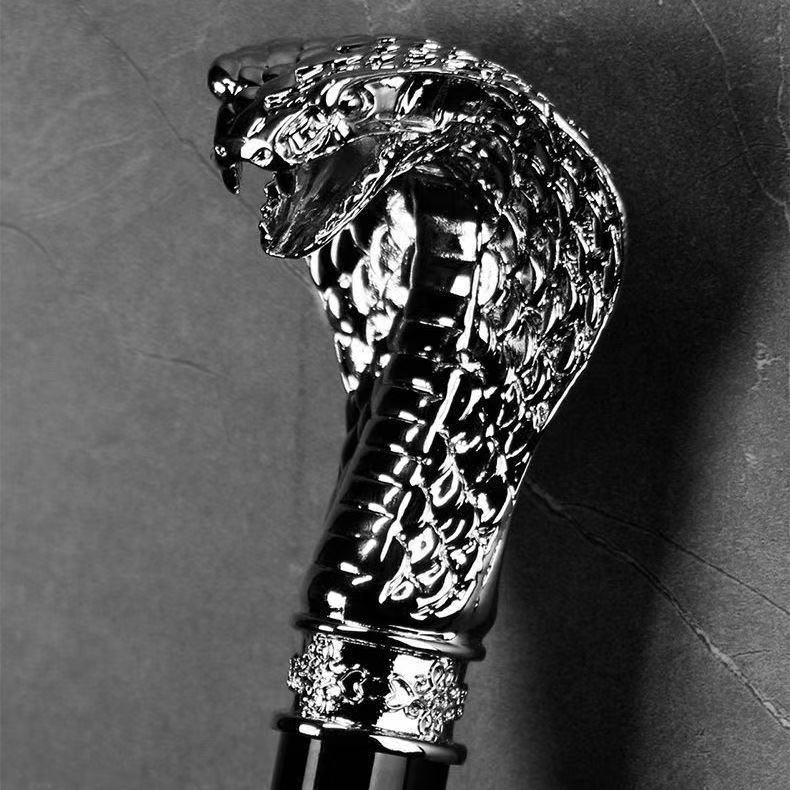
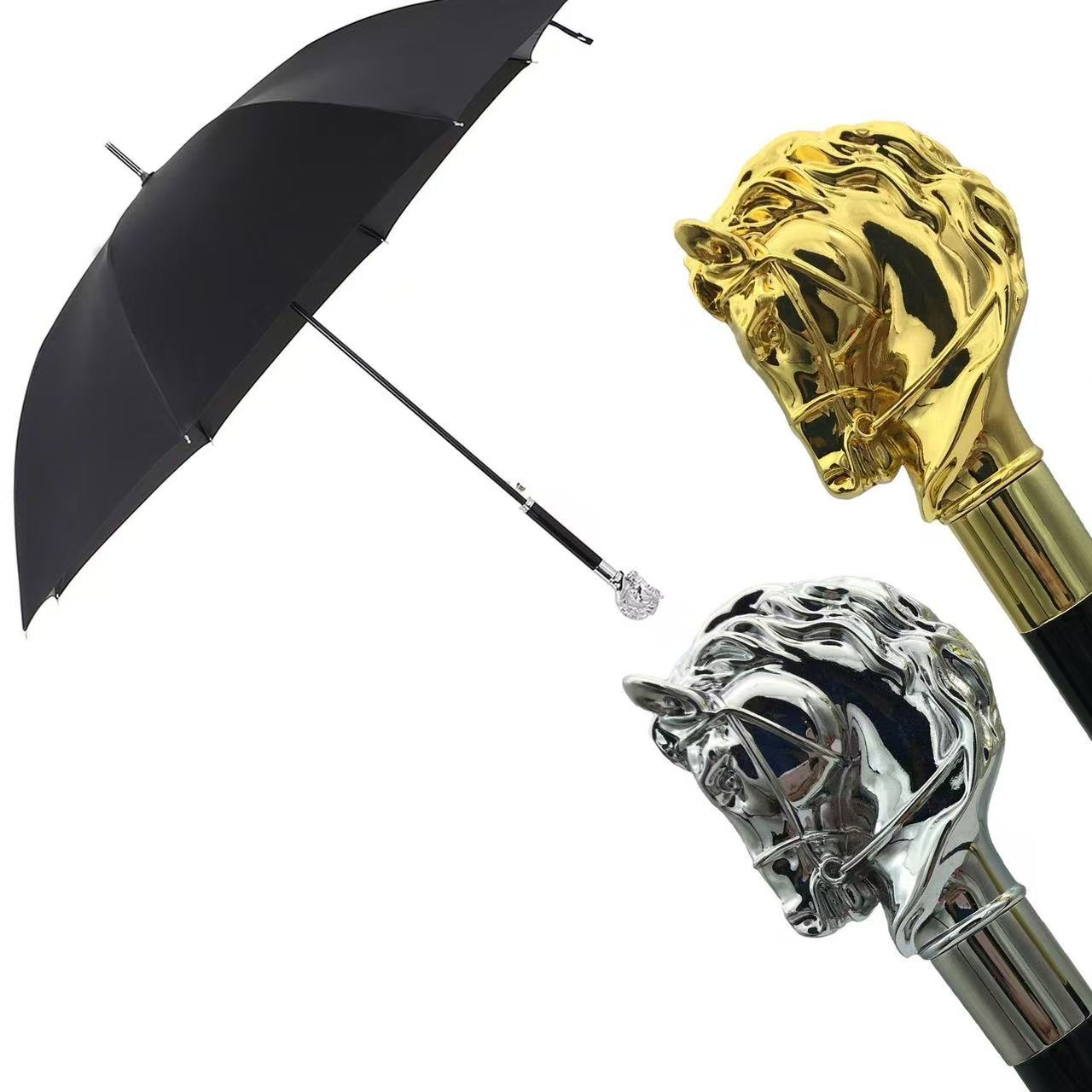
The cobra-shaped and horse-head handle images are publicly approved reference images supplied for this article. Neither represents the Australian customer’s design, a sample produced for this inquiry or evidence of a confirmed manufacturing material.
Project at a Glance
| Item | Current information |
|---|---|
| Customer location | Australia |
| Product concept | Branded umbrella with colorful canopy printing and a bespoke handle |
| Proposed canopy process | Digital dye-sublimation printing, subject to the selected umbrella fabric |
| Frame requirement | A sturdy, durable, premium configuration appropriate to the umbrella’s size and functions |
| Planned handle designs | Four |
| Initial quantity under consideration | 100–200 handles per design |
| Development approach | Prototype first; validate material and use performance; then compare production routes |
| Status of costs | Preliminary, project-specific budget estimates—not fixed prices for all custom handles |
Why Is the Handle the Main Development Challenge?
The canopy, frame and handle need to work together, but they do not present the same development questions.
For the canopy, the customer supplies the colored artwork. Because the initial quantity is small, our proposed route is digital dye-sublimation printing, with suitability confirmed against the fabric ultimately selected.
For the frame, we can assess an appropriate premium configuration based on the complete umbrella’s size, intended functions and product positioning. A request for a sturdy umbrella still needs to become an agreed specification.
The handle is different: the customer wants his own shape, so an existing component cannot simply be selected. A separate prototype and a suitable production method must be developed.
A bespoke handle can involve much more than adding a logo. An animal-shaped design may include a sculpted head, surface texture and projecting details. Those features affect whether the part can be released from a mold, whether it must be split into separate components, and how it will be finished and assembled.
Two handles of similar overall size can therefore have different development costs. Size and material weight alone do not describe the manufacturing work.
Why Make a 3D-Printed Handle Prototype First?
A drawing cannot fully establish how a handle feels in the hand or looks when assembled onto an umbrella. A physical prototype allows the buyer and supplier to check:
- Whether the actual dimensions suit the intended use.
- Whether the grip is comfortable.
- Whether the handle fits and looks proportionate on the complete umbrella.
Based on preliminary discussions with the supplier for this inquiry, one 3D-printed handle prototype was estimated at approximately RMB 500–600.
Printing may be followed by sanding, painting or electroplating to demonstrate the intended appearance. The appropriate finishing route and what is included in the quotation must be agreed in advance; the estimate should not be read as an all-inclusive price for every finish.
An Appearance Prototype Is Not Automatically a Production-Ready Handle
The photopolymer-resin prototype currently being considered is primarily for checking design and assembly. Its suitability for a finished umbrella still requires strength and durability evaluation. Visual approval alone is not a reason to deliver it as an end-use product.
This does not mean every 3D-printed part is fragile or suitable only for prototyping. Production suitability depends on the material, printing process, structure and validation. Additive manufacturing can also be used for end-use production, as illustrated by Materialise’s manufacturing services. That general capability does not establish the performance of the resin prototype proposed for this inquiry.
Could Silicone-Mold Casting Suit 100–200 Handles per Design?
The customer is currently considering four designs, initially at 100–200 handles per design. Separate injection molds for every design could make the initial investment substantial. Producing every handle using the currently discussed prototype-printing route would also have an unattractive unit cost.
We are therefore assessing silicone-mold replication as another route.
What Does Silicone-Mold Replication Involve?
The basic sequence is to make a master pattern, produce a silicone mold around it, and cast material in that mold to reproduce the handle.
Vacuum casting in silicone molds commonly uses polyurethane or other casting resins. A material described as “ABS-like” should not be assumed to be conventional injection-molded ABS. The actual resin grade and performance need to be confirmed. Protolis’s vacuum-casting description provides background on this process.
What Costs and Performance Questions Remain?
Silicone tooling can involve a lower initial investment than injection tooling, making it worth assessing for a small batch. However, silicone molds have a limited working life. Replacement molds, labor and production losses must be included in the comparison.
The preliminary supplier discussion indicated a cast-handle unit cost of a little over RMB 100 for this proposed design. This is only an indicative budget, not a finalized quotation or a general market price. Drawings, size, material weight, structure and finishing requirements can change the result.
Before a cast handle is accepted for sale as part of a finished umbrella, sample evaluation is still required. Particular attention should be paid to the handle-to-shaft connection and performance under relevant drop and twisting checks. No completed test results are claimed for this inquiry.
When Should Injection Molding Be Compared?
Injection molding is another option. Our preliminary estimate for tooling of this type is approximately RMB 10,000–20,000 per mold, depending on the handle structure, number of parts and tooling requirements.
Its larger upfront investment can be spread across more units as production quantities increase. Depending on the design and production plan, that may make the unit economics more favorable.
There is no universal rule that injection tooling becomes worthwhile only after an order reaches tens of thousands of handles. The useful question is which route has the more appropriate total cost and technical performance for the quantity of each design and the realistic repeat-order plan.
If the four designs cannot share tooling, their tooling costs must be assessed separately. Adding all four quantities together does not remove the cost of developing four different shapes.
Development and Production Routes Compared
| Route | Role in this inquiry | What must be checked |
|---|---|---|
| 3D-printed prototype | Confirm size, grip, appearance and assembly | Material, finishing inclusions and the distinction between appearance approval and end-use validation |
| Silicone-mold casting | Evaluate small batches of 100–200 handles per design | Resin grade, connection strength, use performance, replacement molds, labor and losses |
| Injection molding | Compare for a suitable quantity and repeat-order plan | Tooling per design, part splits, total investment, unit cost and agreed product requirements |
These are options under assessment, not approved production instructions or universal quantity thresholds.
Why Are Drawings Essential for an Accurate Quote?
A simple one-piece handle and a complex multi-part handle can require very different manufacturing work. One design may use one mold; another may need separate tools for individual components followed by additional assembly.
Dimensions, weight, material, the shaft connection and the desired painted or plated appearance also influence price.
Before requesting a firm quotation, prepare the following information:
- Drawings for every handle design and the quantity required for each.
- Handle dimensions, structural details and material requirements.
- The proposed handle-to-shaft connection.
- Surface finish and visual acceptance requirements.
- Whether the shape may require separate parts, multiple molds or additional assembly.
- The scope of sampling, post-processing and shipping included in the quotation.
The figures in this guide help frame an initial budget. A formal quotation requires review of the drawings and agreement on the requirements.
How Much Could a Complete Custom Umbrella Sample Cost?
For this inquiry, the preliminary budget is:
| Sample item | Project-specific preliminary estimate |
|---|---|
| Canopy, frame and other umbrella sample elements, excluding the bespoke handle | Approximately RMB 200 |
| 3D-printed bespoke handle prototype | Approximately RMB 500–600 |
| Complete assembled sample, including the above elements, labor, assembly and some finishing | Approximately RMB 1,000 overall |
The approximately RMB 1,000 figure is the estimated overall sample budget, not an additional charge on top of the first two rows.
Some additional costs have not yet been included. A more complex handle or special surface treatment could change the budget. Buyers should confirm the quotation’s inclusions before authorizing sampling.
A Practical Development Sequence for Buyers
- Review the drawings and quantities. Identify which requirements apply to each design.
- Make a physical prototype. Check its dimensions, grip and assembly on the umbrella.
- Validate the proposed material and use performance. Do not confuse an approved appearance with a proven end-use component.
- Compare production routes by design. Include tooling, replacement molds, finishing, labor and assembly in the total cost.
- Confirm the specification and quotation before production. Agree on appearance, performance requirements and cost inclusions.
This staged approach makes design, cost and quality decisions visible before committing to production.
Frequently Asked Questions
Can I Develop an Umbrella with My Own Handle Shape?
A bespoke handle can be assessed from your drawings rather than selected from existing stock. The shape, material, shaft connection, surface finish and quantity determine the development work. A physical prototype is useful before choosing the production route; feasibility and final cost remain subject to technical review.
Is a 3D-Printed Handle Suitable for a Finished Umbrella?
Not automatically. The photopolymer-resin prototype considered in this inquiry is primarily intended for design and assembly checks. Its end-use suitability has not been established. Other 3D-printing materials and processes may be suitable for production, but the actual component still needs an appropriate specification and validation.
Is Silicone-Mold Casting the Best Choice for 100–200 Handles?
It is an option to assess, not an automatic best choice. In this inquiry, it may reduce the initial tooling investment compared with separate injection molds. Resin performance, replacement molds, labor, finishing and production losses still need to be checked. “ABS-like” casting resin should not be treated as identical to conventional injection-molded ABS.
Do I Need Tens of Thousands of Handles Before Paying for an Injection Mold?
There is no fixed threshold that applies to every handle. Compare tooling and production costs for each design, the required material and structure, and expected repeat orders. A combined quantity covering several different designs can be misleading if each design requires separate tooling.
Is RMB 1,000 a Fixed Price for a Complete Custom Umbrella Sample?
No. Approximately RMB 1,000 is the preliminary overall sample budget for this inquiry, including the umbrella sample elements, a handle prototype, assembly, labor and some finishing. It is not an additional fee on top of those components. Extra requirements and costs not yet included may change the final quotation.
Conclusion: Confirm the Design, Then Validate the Production Route
The appropriate way to develop a custom umbrella handle is not to select a manufacturing process from quantity alone. Start with a physical prototype, establish the material and performance requirements, and compare production costs for each design.
At Hand in Hand Umbrella Factory, this Australian inquiry is being approached as a staged development assessment. The objective is to clarify appearance, fit, cost and quality requirements before a production commitment—not to assume that an attractive prototype is already a finished product.
Case Source and Technical References
The case details and preliminary RMB budgets come from Hand in Hand Umbrella Factory’s Australian customer inquiry and related supplier discussions. The customer’s confidential design is withheld. Both reference images were supplied and approved for public use and do not document this customer’s product.
The Materialise and Protolis links explain general manufacturing processes only; they do not verify this inquiry’s prices, materials or test results.
Related Buyer Guides
For a related development assessment, read our German fashion-brand small-batch customization case. For a different handle material and process, see how wooden umbrella handles are manufactured.