Custom umbrella artwork guide
Custom Umbrella Printing Methods: Screen Printing vs. Dye Sublimation vs. Heat Transfer
The right umbrella printing method depends on the artwork area, number of colors, fabric, order quantity, required surface feel and durability—not simply on which process has the lowest unit price.
At-a-glance comparison
Which printing method is best for a custom umbrella?
There is no single best process for every promotional umbrella. The practical goal is to reproduce the approved artwork clearly while keeping the canopy flexible, the production method stable and the total cost appropriate for the order.
| Method | Best use | Artwork | Surface feel | Main limitation |
|---|---|---|---|---|
| Screen printing | Small logos and text | One or a few solid colors | A light ink layer can be felt | Each color normally needs a separate screen |
| Halftone screen printing | Small detailed graphics | Shading, tonal changes and selected complex images | Similar to screen printing | More setup and tighter process control |
| Dye sublimation | Large areas and full panels | Photos, gradients, patterns and many colors | Smooth; no heavy surface ink layer | Fabric and base-color compatibility must be confirmed |
| Heat-transfer film | Small complex full-color graphics | Fine detail, gradients and low-color-count-independent designs | A transferred layer is usually noticeable | Large areas can feel stiff and become expensive |
Method 01
Screen printing: the standard choice for simple custom umbrella logos
Screen printing is the most common process for promotional umbrellas with a small logo, company name, event message or contact details. Ink is pushed through a prepared mesh screen onto an umbrella fabric panel. The printed panels are dried before sewing and umbrella assembly.
One solid color normally requires one screen. A two-color logo usually needs two separated screens and two controlled printing passes. This is why a supplier needs the color count, print size and number of printed panels before giving an accurate quotation.
A common specification mistake
Why ordinary screen printing is often unsuitable for a large umbrella graphic
Larger screens and more setup
A large image needs larger equipment and more careful handling, which increases production difficulty.
More ink on the canopy
Screen-printing ink sits on the fabric surface. A large covered area creates a more noticeable ink layer.
Reduced canopy flexibility
Heavy ink coverage can make the fabric stiffer and may affect the natural tension and appearance of the open umbrella.
Production principle: a process may be technically possible without being the most suitable option. Full-panel color artwork should normally be evaluated for dye sublimation before a buyer approves large-area screen printing.
Specialized screen process
What is halftone or color-separated screen printing?
Some artwork contains a portrait, tonal shading, a gradient or detailed illustration but is still intended for a relatively small print area. A printer may reproduce it with finer color separation and halftone dots rather than ordinary solid-color screens.
This approach can show more detail than basic screen printing, but it still belongs to the screen-printing family. It requires more artwork preparation, more accurate registration and tighter print control. Large coverage can still create the same ink-layer and canopy-stiffness concerns.
Method 02
Dye-sublimation printing: best for full-color and full-panel umbrella designs
In dye-sublimation printing, the artwork is first printed onto transfer paper and then transferred to compatible umbrella fabric using controlled heat and pressure. The color becomes part of, or bonds closely with, the textile rather than forming a thick ink layer on top.
This method is usually the strongest candidate for photographic artwork, gradients, continuous patterns, a complete panel design or an image that runs across multiple umbrella panels.
Photos and gradients
Many colors and smooth transitions can be reproduced without preparing one ordinary screen for each color.
Panel and all-over designs
The artwork and background can be transferred as one coordinated surface design.
A smoother fabric surface
The finished panel normally avoids the heavy raised ink feel associated with large-area screen printing.
Material compatibility
The fabric composition, base color, coating and required color result must be confirmed before production.
Production reality
Why a small logo does not always justify dye sublimation
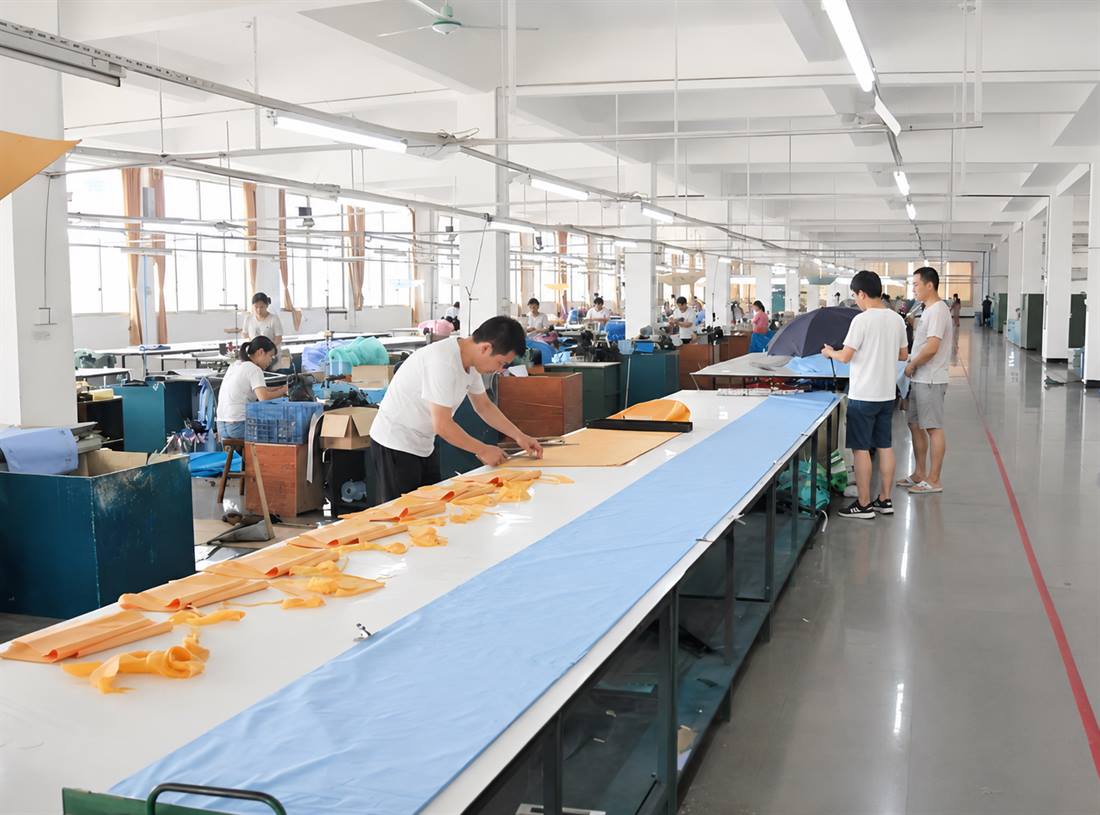
Sublimation can produce excellent full-color results, but the production may involve transferring a complete piece of fabric or a full umbrella panel to keep the background and artwork consistent.
If the requirement is only a small one-color logo, processing the whole panel may add unnecessary cost. Screen printing can be the more direct and economical solution.
Buyers should compare the complete production route, not assume that a more advanced-sounding process is automatically better.
Method 03
Heat-transfer film: useful for a small, detailed full-color graphic
Heat-transfer film—sometimes described as a heat-press transfer—is prepared separately and bonded to the umbrella fabric with heat and pressure. Unlike dye sublimation, it normally leaves a transferred layer on the fabric surface.
It can be useful for a small graphic with many colors, fine detail or gradients, especially when the order quantity does not make multiple screen setups practical.
However, a large transfer area can feel less flexible, cost more and require additional durability testing. Buyers should confirm the film type, edge appearance, adhesion and compatibility with the canopy fabric.
Buyer decision path
How to choose the right umbrella logo printing process
Start with the design and use case, then let the supplier compare workable processes. Do not select a method by name before the artwork, canopy material and order quantity are reviewed.
- 1
Define the print area
Small logo, half panel, full panel or a design continuing across several panels?
- 2
Check the artwork
Solid colors, fine lines, gradients, a photograph or a continuous pattern?
- 3
Confirm the material
Fabric composition, base color, coating and water-repellent finish can affect process compatibility.
- 4
Confirm quantity and standards
Setup cost, repeatability, ink or material requirements and testing expectations change the quotation.
- 5
Approve a physical sample
Check color, position, detail, hand feel, adhesion and the appearance of the opened umbrella.
Before requesting a quotation
What information should a buyer send to an umbrella manufacturer?
Complete artwork information helps the factory recommend the right process and prevents a quotation based on assumptions.
- Vector artwork or the highest-resolution available design file
- Number of solid colors and any gradients, shadows or photographs
- Required print size and the number of printed umbrella panels
- Umbrella type, canopy fabric and canopy color
- Order quantity and required delivery date
- Pantone or other color references when color matching matters
- Ink, chemical, environmental or market-compliance requirements
- Packaging, inspection and sample-approval requirements
Frequently asked questions
Custom umbrella printing FAQ
What is the best printing method for a one-color logo on an umbrella?
Screen printing is usually the most practical choice for a small one-color logo. It is a mature process, produces a clear solid color and is economical for suitable quantities.
Which process is best for a full-panel custom umbrella design?
Dye-sublimation printing is normally preferred for full-panel, photographic, gradient or continuous-pattern artwork on compatible fabric because it provides large color coverage without a heavy surface ink layer.
Why can large-area screen printing make an umbrella canopy stiff?
Screen-printing ink sits on the fabric surface. A large printed area requires more ink, creating a more noticeable layer that can reduce fabric flexibility and affect canopy tension.
Is heat-transfer film the same as dye sublimation?
No. Dye sublimation transfers color into or closely with compatible textile fibers. Heat-transfer film bonds a prepared graphic layer onto the fabric surface, so its hand feel and material requirements are different.
Can an umbrella manufacturer print a gradient logo?
Yes. Depending on print area, quantity, fabric and detail, the supplier may recommend halftone screen printing, heat-transfer film or dye sublimation. A physical sample should be approved before bulk production.
What affects the cost of custom umbrella printing?
Key factors include print area, number of printed panels, color count, artwork complexity, setup requirements, fabric, order quantity, ink or material standard, color tolerance and sample requirements.