
By Aihua Chen | Hand in Hand Umbrella / Guangzhou Hand in Hand Umbrella Factory
Direct answer: why do umbrella handles come loose?
Umbrella handles can come loose when the adhesive does not suit the materials, too little glue or bonded area is available, the shaft-to-handle gap is unsuitable, or temperature and curing conditions weaken the connection. For export orders, transport, storage and destination conditions also matter. A two-part adhesive, often called “AB glue” in Chinese manufacturing, can be part of an improved fixing process, but it does not replace correct fit, alignment and curing time. Buyers should confirm the actual adhesive, assembly method and finished-product acceptance requirements instead of relying on the adhesive category alone.
Experience and scope: what do these cases establish?
My experience in the umbrella industry began in 2000. At Hand in Hand Umbrella, we have handled a loose-handle problem on an export order to South Korea. Separately, an industry peer at another umbrella company told me about wooden handles coming off that company’s order for a US customer. Those umbrellas were not manufactured or supplied by Hand in Hand Umbrella. These experiences explain why we pay attention to the entire handle-fixing process, not only whether the handle feels secure immediately after assembly.
The cases below are production experience and contemporary cause assessments, not laboratory findings or universal conclusions about an adhesive type. External technical references explain general bonding principles; they do not certify our umbrellas or demonstrate that the historical orders underwent the inspection methods suggested here.
What did two export-order complaints teach us?
A separate umbrella company’s US order — not a Hand in Hand Umbrella order
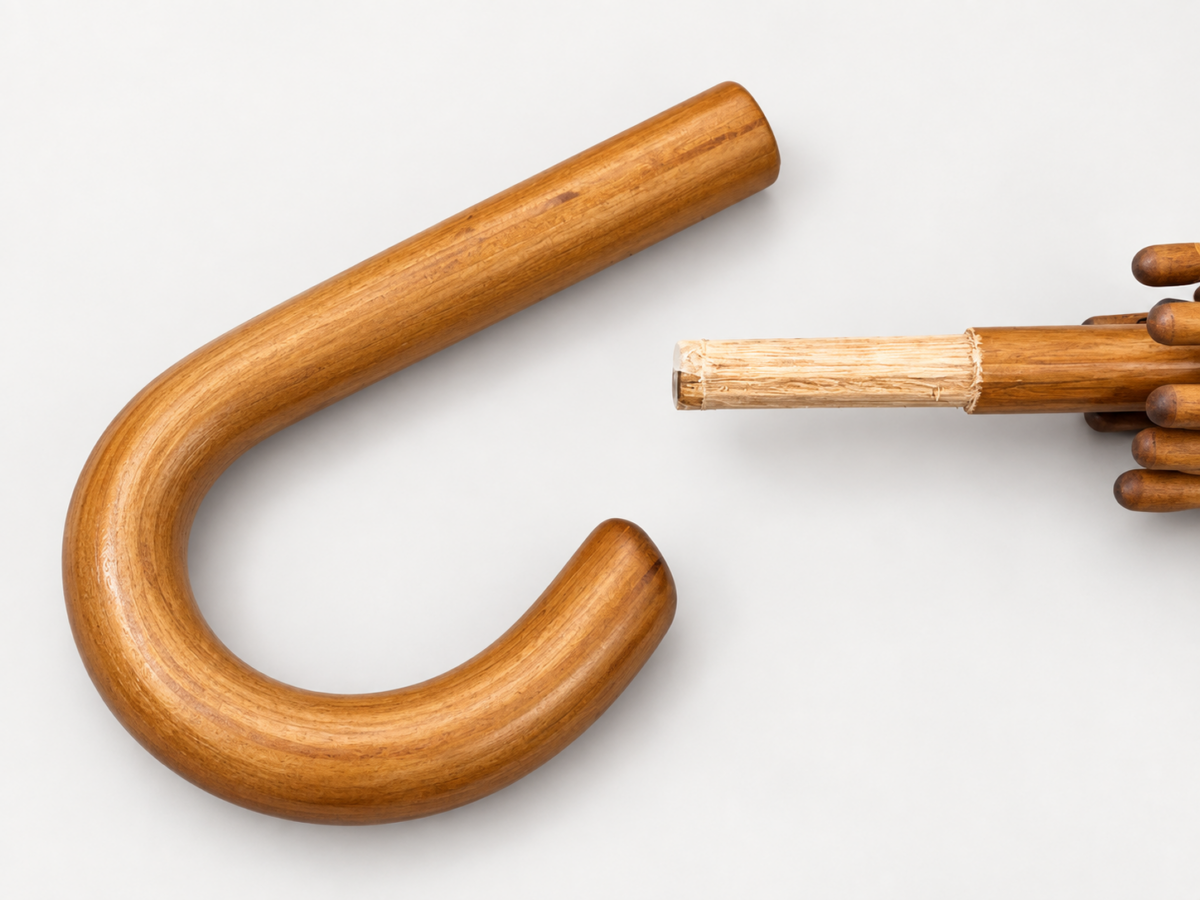
An industry peer from another umbrella company sent me photographs after that company’s US customer reported that wooden handles had come off its umbrellas. This was the other company’s order, not an order manufactured or supplied by Hand in Hand Umbrella. My first question was how that company had fixed the handles to the shafts. The peer explained that it had used hot-melt glue.
In our discussion, we identified transport temperature, glue quantity and the connection gap as areas to investigate. We could not determine the root cause from the photographs. In particular, we could not conclude that heat during sea freight caused the failure.
Our own order to South Korea around 2018
Around 2018, we used hot-melt glue to fix handles on an umbrella order for South Korea because the delivery schedule was tight. After the umbrellas arrived, handles came off in cold conditions.
Our assessment at the time was that a change in the performance of the particular glue at low temperature may have allowed the adhesive layer to crack under load. The customer was a trading company; it handled the subsequent issue, and we provided compensation.
This experience changed what we look for during assembly. We need to consider whether the joint remains stable after transport and environmental changes, not just at the moment the handle is installed. This was our assessment of that order, not a finding that every hot-melt adhesive behaves the same way.
How do hot-melt, general-purpose and two-part adhesives differ?
In the production settings we have encountered, these three adhesive categories involve different assembly routines and controls.
| Method | Basic process | Observed production characteristics | What to confirm |
|---|---|---|---|
| Hot-melt adhesive | Heat the adhesive, apply it, assemble the joint and allow it to cool. | The common grades we have encountered allow quick assembly and provide some gap filling. | Grade-specific temperature resistance, material compatibility, glue quantity and assembly timing. |
| General-purpose adhesive, sometimes marketed as “universal glue” | Apply and assemble according to the product instructions, then allow the bond to stabilize. | The procedure depends on the formulation; the label alone does not specify the application method. | Suitable materials, surface preparation, application and assembly requirements. |
| Two-part adhesive (“AB glue”) | Mix two components in the specified ratio, apply, assemble and allow curing. | Mixing, alignment and waiting time need to be managed. | Mix ratio, mixing quality, gap suitability, curing conditions and handling time. |
“AB glue” means a two-component adhesive, not one particular chemistry. It should not automatically be translated as epoxy. Likewise, “universal glue” does not mean an adhesive is suitable for every material. Wooden handles, plastic handles and surface-treated metal shafts must be assessed using their actual materials.
3M’s structural adhesive FAQs explain that two-part adhesives include different chemistries, and that adhesive selection, surface preparation and curing requirements depend on the application and substrates. This is general technical guidance, not a recommendation of a particular brand or grade for every umbrella.
Why do some promotional umbrella factories use hot-melt glue?
The main attractions are convenient assembly and a fast production sequence. In processes I have seen, an operator heats the adhesive, dips the shaft end into it and inserts the shaft into the handle. Once the glue cools, the assembly can move relatively quickly to the next operation.
Hot-melt adhesive also has some bulk, which can help fill space between the shaft and the handle hole. For larger promotional umbrella orders with defined costs and delivery schedules, those characteristics can be useful for organizing production.
These are observations from some factories, not a measurement of how widely the method is used across the industry. Whether it is suitable depends on the materials, joint design and expected environment.
Why should both high and low temperatures be investigated?
Environmental suitability depends on the specific formulation. A hot-melt adhesive with insufficient cold resistance may crack under load at low temperature. An adhesive that lacks suitable heat resistance may also lose joint stability at higher temperatures.
Henkel’s hot-melt troubleshooting guidance treats cold cracking and heat-related failures as different issues and discusses formulation suitability. Its examples concern packaging bonds. They help explain the selection principle but cannot replace validation of a completed umbrella.
For a sea-freight order, the container’s position, sun exposure and shipping route are useful investigation details. No verifiable internal container-temperature record was available for the other umbrella company’s US order, so high temperature remained a possible factor, not a confirmed cause.
Buyers should explain the transport method and destination environment before adhesive selection, review the relevant technical data and agree on an appropriate finished-product check. The temperature used to melt or apply an adhesive is not the temperature rating of the completed joint.
Why does the assembly gap still matter after switching to AB glue?
The shaft fits inside a hole in the handle, and assembly normally requires some clearance. If that gap is too large and the adhesive does not form a sufficient connection, the handle can still loosen or detach.
We have observed two ways of dealing with clearance in production:
- Some manufacturers mix fine sand into adhesive as a filler.
- In some Japanese umbrella-making processes we observed, thread was wound around the insertion end of the shaft to increase its thickness before adhesive assembly.
These are descriptions of observed practices, not instructions to add filler or thread to every joint. Any such change needs validation with the particular adhesive, materials and connection. A tight-feeling fit alone does not prove that a bond is reliable.
For procurement, confirm consistent shaft-to-hole fit, glue quantity, remaining voids after assembly and whether the finished connection meets the agreed requirements.
Why can a heat-inserted plastic handle wobble without coming off?
Heat insertion uses a heated shaft end to soften the plastic at the contact area; cooling then fixes the assembly. In processes we have seen, manufacturers heated the insertion end of a steel shaft with a natural-gas burner before inserting it into a plastic handle. Some slightly flattened the end first to improve retention.
This is a process observation, not a temperature recipe or a DIY repair instruction. More heat does not automatically create a stronger joint.
Sometimes the handle remains attached but slight movement can be felt when it is gently rocked. Areas to investigate include local gaps, dimensional fit and how the contact area formed during assembly.
Handle detachment and handle wobble are separate inspection points. A handle that has not separated is not necessarily a handle with a stable grip.
Why do we generally use two-part adhesive and allow undisturbed curing?
Based on our experience handling orders, we now generally use two-part adhesive to fix umbrella handles and are working toward consistent use of that process. Alignment and undisturbed waiting time are important parts of the assembly requirements.
A newly bonded handle has not yet reached its final condition. Moving the umbrella immediately, rotating the handle or loading the joint can disturb the intended position and direction.
After assembly, the handle must stay aligned while the adhesive reaches the strength required for the next operation. Handling time and full cure are different stages. A surface that looks dry does not establish that the joint has fully cured.
Compared with the hot-melt assembly process we used previously, this arrangement needs more waiting time and affects production throughput. We allow that time because joint stability and grip feel deserve attention.
This choice comes from our production experience. It does not mean that any two-part adhesive will suit any handle. The actual adhesive and assembly conditions still need to be matched; the words “AB glue” cannot replace process control.
Which six points should buyers specify and inspect?
- Materials and fixing method. Identify the handle and shaft materials, and whether the connection uses adhesive, heat insertion or another agreed method.
- Actual adhesive product. Record the grade and suitable substrates, not just “good glue” or “AB glue.”
- Assembly fit. Agree on shaft-to-hole fit, clearance treatment and glue application requirements.
- Alignment and curing. Confirm how the handle stays correctly oriented and when the assembly may be moved or sent to the next operation.
- Environmental suitability. Include transport, storage and destination conditions in selection and finished-product validation.
- Finished-product acceptance. Check loosening, rotation, wobble and separation. If quantitative checks are needed, agree in advance on pull-out, torsion or temperature-conditioned test methods, sampling and acceptance criteria.
These are procurement and acceptance recommendations, not one universal test standard. They do not mean the historical orders described above completed those tests.
For related manufacturing details, see our wooden umbrella handle manufacturing guide and umbrella quality control guide. At the sampling stage, send us your intended use, export market, handle material and delivery requirement so the assembly and acceptance requirements can be discussed together.
Frequently asked questions
Is a wooden umbrella handle coming off necessarily a wood-quality problem?
No. Check adhesive compatibility, glue quantity and bonded area, the fit between the shaft and handle hole, and curing and transport conditions. A photograph and a customer complaint alone cannot establish the root cause.
Do umbrella handles fixed with hot-melt glue always come off easily?
No. Hot-melt formulations, temperature resistance and assembly conditions differ. A failure in one order is not evidence that all hot-melt-bonded handles will fail. Assess the specific adhesive data and the finished assembly.
How long must a two-part adhesive cure before an umbrella can be moved?
There is no universal waiting time for all two-part adhesives. Follow the actual product instructions, mixing ratio and production temperature. Distinguish handling strength from full cure and keep the handle aligned until the relevant stage is reached.
Should a handle that wobbles but does not detach be investigated?
Yes. Wobble affects grip feel and may indicate a problem with fit or fixation. Check the joint against the approved sample and the agreed acceptance requirements; resistance to complete separation is not the same as a stable grip.
What do buyers commonly overlook when specifying export umbrella handles?
Buyers may check whether the sample feels secure at the time but overlook transport conditions, destination temperatures, adhesive compatibility and the curing schedule. Agree on those conditions before production rather than asking only which glue was used after a problem occurs.
Conclusion: a secure handle depends on the entire joint
Reliable umbrella handle fixing requires more than choosing between hot-melt glue and two-part adhesive. Material compatibility, joint clearance, glue application, alignment, curing and expected conditions all need attention. The useful purchasing question is not simply “Which glue do you use?” but “How will this particular connection be assembled and accepted?”
Experience source: Aihua Chen, Hand in Hand Umbrella / Guangzhou Hand in Hand Umbrella Factory; umbrella industry experience since 2000. The cases come from our own production experience and industry discussions. Historical causes are presented as the assessments made at the time. The external references explain general bonding principles and do not imply brand endorsement. Each project remains subject to the adhesive technical data, approved sample and agreed acceptance requirements.