
By Aihua Chen | Hand in Hand Umbrella Factory
Choose an umbrella handle by its base material, surface finish, grip, budget and intended use—not just how a new sample feels. For projects focused on a substantial feel and long-term use, I usually evaluate well-made wooden handles first. EVA foam, uncoated ABS, rubberized coatings, silver-painted ABS and electroplated finishes are also options, but each needs its own sample checks. No material name alone guarantees a longer service life.
When developing an umbrella, I ask a simple question: will this handle still feel comfortable and look acceptable after repeated use or a period in storage?
I have encountered some black foam handles that later shed particles or left marks, and some soft-touch coated handles that became sticky. These are observations from particular products I have handled, not a controlled comparison of every material or a statement about all handles of that type.
First, separate the handle material from its finish
A “rubber handle” may mean a handle made from rubber, or an ABS plastic handle with a rubberized, soft-touch coating. Those are different specifications.
Likewise, a silver-looking handle may be painted plastic rather than metal. Silver spray paint and electroplating are different processes. “Matte,” “textured” and “rubber feel” describe appearance or touch, not a complete material specification.
Ask the supplier to list base material and surface finish separately in the quotation and approved sample record.
Umbrella handle comparison: what should buyers check?
This is a selection guide, not a durability ranking.
| Handle option | Why consider it? | Main sample checks |
|---|---|---|
| EVA foam | A cushioned grip; an option to compare across different budgets | Particle shedding, wipe residue, cleaning and surface condition after use or storage |
| Rubber handle | A specific rubber grip and construction | Actual material, surface stability, fit, grip and project-specific price |
| ABS with rubberized coating | A soft-touch surface over a plastic body | Stickiness, residue transfer, peeling and coating consistency |
| Uncoated ABS | A molded plastic surface without the additional finish shown on coated versions | Mold quality, sharp edges, grip, appearance and shaft fit; do not assume a particular lifespan |
| Silver-painted ABS | A silver appearance without specifying a metal body | Paint adhesion, rubbing wear, exposed base material and consistent coverage |
| Electroplated ABS | A plated appearance to evaluate for the design | Plating adhesion, wear, edge quality and agreed test conditions |
| Wood | A natural appearance and substantial feel | Timber selection, drying, sanding, finish, moisture management and secure attachment |
Two handles with the same material description can perform differently because of their formulation, construction, processing and finish. Compare the actual specification and sample.
How do the seven pictured samples relate to these choices?
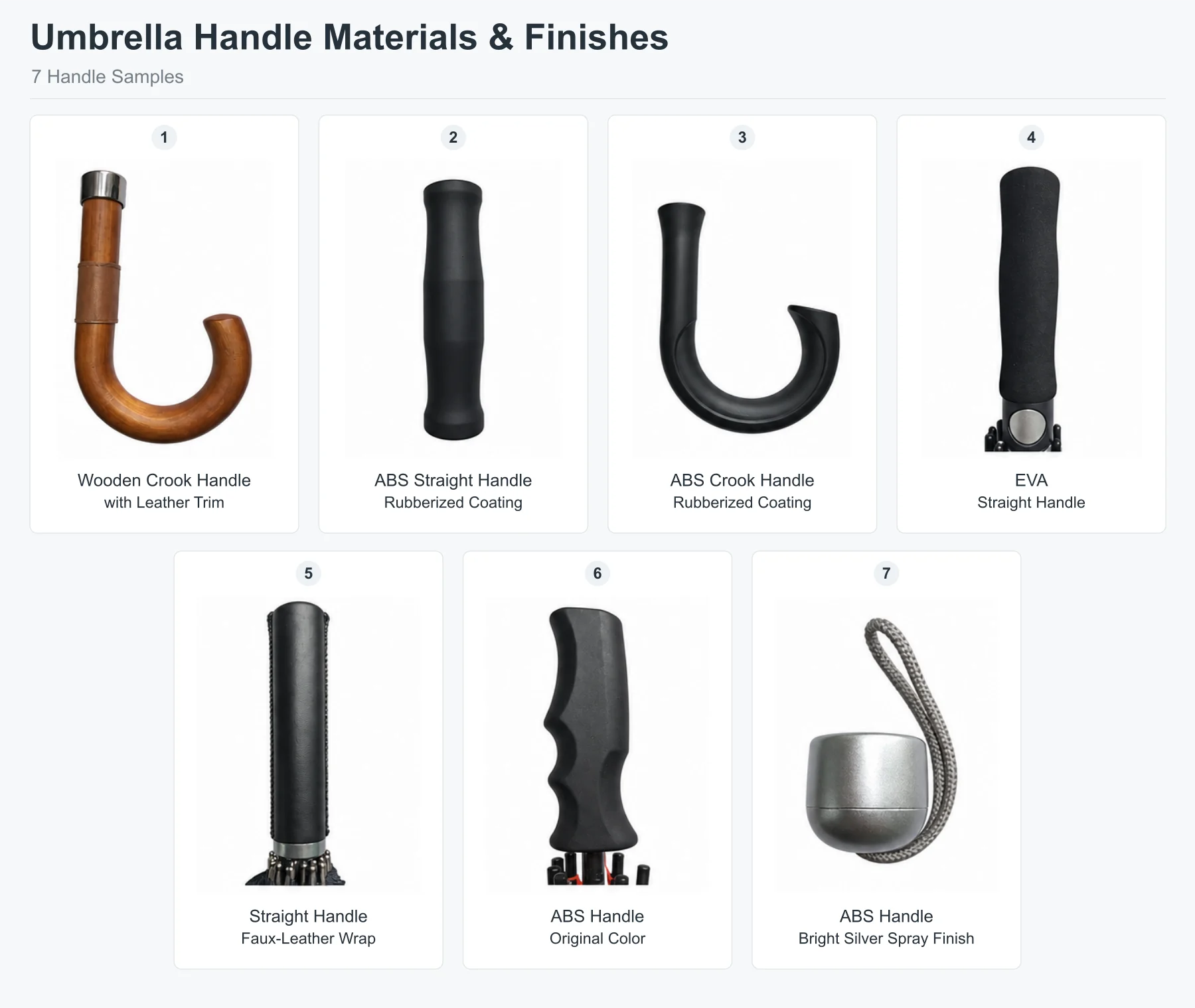
The supplied comparison image shows:
- Wooden crook handle with leather trim.
- ABS straight handle with a rubberized coating.
- ABS crook handle with a rubberized coating.
- EVA straight handle.
- Straight handle with a faux-leather wrap.
- ABS handle in its original material color.
- ABS handle with a bright silver spray finish.
The seventh sample is silver-painted ABS, not an electroplated handle. Electroplating is discussed as a separate option, not shown as that sample’s finish. A faux-leather wrap is also a covering; it does not identify the underlying handle material.
Image note: an AI-assisted background-removal and layout composite of supplied handle sample photographs, with English labels. The image illustrates sample types; it is not evidence of durability-test results.
Why do I often start with a well-made wooden handle?
For buyers who want a handle with character and a substantial feel, I often bring out wooden samples first. I look for comfortable shaping, careful sanding, suitable timber and a consistent finish.
However, “wooden” does not automatically mean well made. I have handled examples where a light scratch exposed a noticeably different color beneath the finish. Attractive grain alone does not establish coating quality or secure assembly.
Wood also exchanges moisture with its surroundings. The USDA Forest Products Laboratory explains that appropriate drying, handling and storage help limit subsequent moisture changes and related dimensional movement. A good-looking coating does not remove the need to discuss drying and storage. USDA Wood Handbook: drying and moisture control
My preference is therefore conditional: suitable timber, proper drying, a smooth and stable finish, and a secure connection to the umbrella shaft. Labels such as “high density” or “fast-growing wood” are not substitutes for examining the finished handle.
Do EVA umbrella handles always shed black particles?
No. Some black foam handles I encountered developed surface particles or powder after more than a year to around two years of use or storage. Some left marks on hands or continued shedding after wiping. That observation is not a universal EVA lifespan.
Nor should every foam be treated as an absorbent sponge. For example, Zotefoams describes its Evazote EV30 grade as closed-cell and reports low water absorption under a specified test. That is information about that grade—not proof that any pictured handle uses it or meets its performance values. EV30 product information
Zotefoams’ weathering guidance also identifies exposure and material-related variables and possible surface changes, including powdering, brittleness and cracking. It cautions against treating accelerated tests as a direct prediction of real outdoor life. Foam weathering guidance
For procurement, check grip and cleaning as well as surface stability. Black residue alone is not enough to diagnose low density or a particular aging mechanism.
Why can a rubberized umbrella handle become sticky?
I have encountered some soft-touch coated handles that became sticky after roughly one or two years of use or storage, sometimes transferring dark residue to the hand. Their initial soft feel did not predict their later surface condition.
Before assigning a cause, establish whether the problem is in the coating or the underlying material. A failing coating on an ABS body does not show that all ABS handles become sticky, and it should not be used to judge handles made from rubber.
In some development options I have reviewed, a rubber-material handle also involved a higher quotation. The actual price depends on the material, construction and purchasing conditions.
A limited budget or short campaign is not a reason to accept shedding, staining or stickiness. Basic usability still needs to be agreed and checked.
Are silver-painted or electroplated ABS handles more durable?
Not automatically. I evaluate these options when a buyer wants a silver or metallic appearance, but the process name is not a guarantee.
Ask the supplier to check:
- Whether the finish adheres consistently, including edges and joints.
- How rubbing affects the appearance and whether the base becomes exposed.
- Whether corners, seams and difficult-to-coat areas are finished consistently.
- Which adhesion or wear test was used, under what conditions, and against which acceptance criteria.
Silver paint is not electroplating, and electroplating does not mean wear-proof. Evaluate each finished sample against the intended use.
Four things to confirm before ordering
- Write a complete specification. Identify the base material, finish, shape and approved sample. Avoid relying on “rubber feel” or “metal look.”
- Inspect the sample in hand. Check for rough edges, shedding, wipe residue and stickiness. Assess grip and attachment to the shaft.
- Match durability evidence to the actual version. Any test or usage feedback should relate to the proposed material and finish. Record conditions and acceptance criteria. A brief handling test cannot prove years of service.
- Consider the complete umbrella. Daily-use, hotel, promotional and premium gift projects have different appearance, handling, maintenance and budget requirements.
If a problem occurs, retain the sample and record its use and storage conditions before asking the supplier to investigate. Do not diagnose the cause from “black residue” or “sticky surface” alone.
For attachment rather than surface-finish questions, see our guide to umbrella handle fixing, hot-melt glue and two-part adhesives. Handle selection should also be included in the custom umbrella order process and quality-control plan.
Frequently asked questions
Is rubberized ABS the same as a rubber handle?
No. Rubberized ABS describes an ABS body with a soft-touch coating. A rubber-material handle is a different construction. Confirm both the base and the surface treatment.
Do all EVA grips leave black marks?
No. Such problems have been observed on particular products, but performance varies with the material grade, formulation, manufacturing and exposure. Inspect and evaluate the specific sample.
Is wood the best handle for a premium umbrella?
It is one option I often evaluate first for its appearance and feel, provided timber selection, drying, finish and attachment are appropriate. Premium positioning does not replace sample inspection.
Does a silver-colored handle mean it is metal or electroplated?
No. The silver sample in the supplied image is ABS with a spray finish. Ask for the base material and finishing process instead of identifying them by color.
How many years should an umbrella handle last?
There is no single lifespan for all handles. Material, finish, usage and storage conditions affect the result. The one-to-two-year observations discussed here concern particular samples, not a general lifespan or warranty promise.
Choosing a handle for your custom umbrella project
Send Hand in Hand Umbrella Factory your intended use, order quantity, preferred handle shape and finish, budget and delivery requirements. We can compare suitable sample options and clarify the material, finish and attachment before production.
The practical starting point is a clearly specified sample—not a material name presented as a guarantee.