Direct Answer: Why Do Umbrellas Leak?
Water under an umbrella can come from fabric seepage, leakage through stitched seams or rain blown in from the side. These are different problems and should not be treated as one fabric defect. Improving rain protection requires a coordinated choice of canopy fabric, needle and thread, sewing quality, canopy structure and finished-umbrella inspection. A water-repellent surface helps droplets roll off, but does not guarantee that water cannot penetrate the fabric or seams. Finer needles, suitable treated thread and a well-designed double canopy may help in the right application; none is a substitute for checking the complete sample under agreed conditions.
Experience and Scope
This guide draws on my practical production experience at Hand in Hand Umbrella Factory, including selected quality-sensitive orders for Japanese customers. Our needle choices and workshop practices are not universal rules for all factories or Japanese orders. The needle numbers below belong to the specification system used in our own production; they are not stitch length, stitch density or stitches per inch.
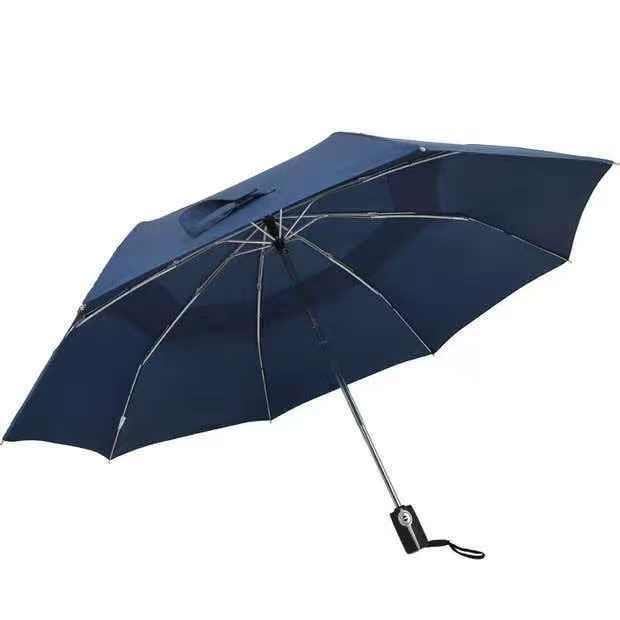
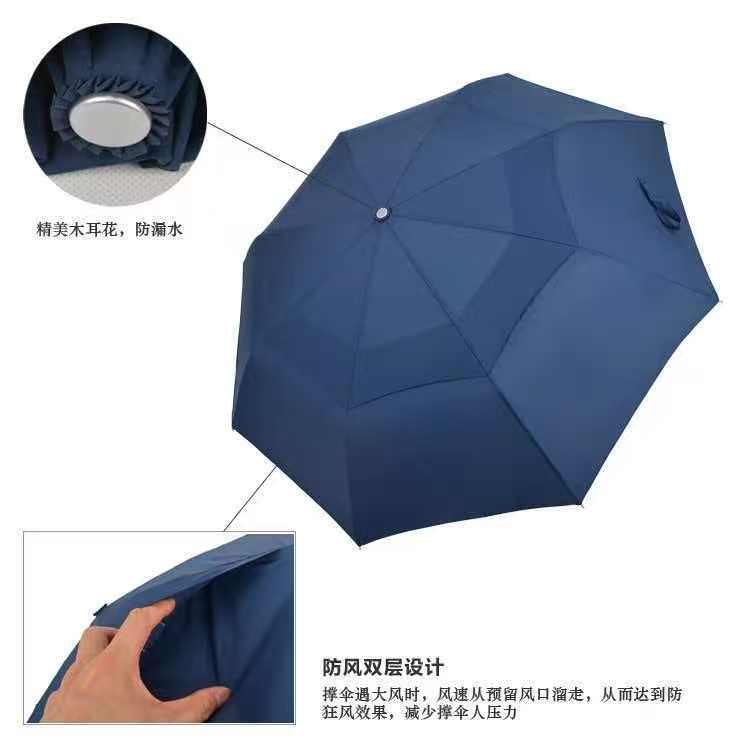
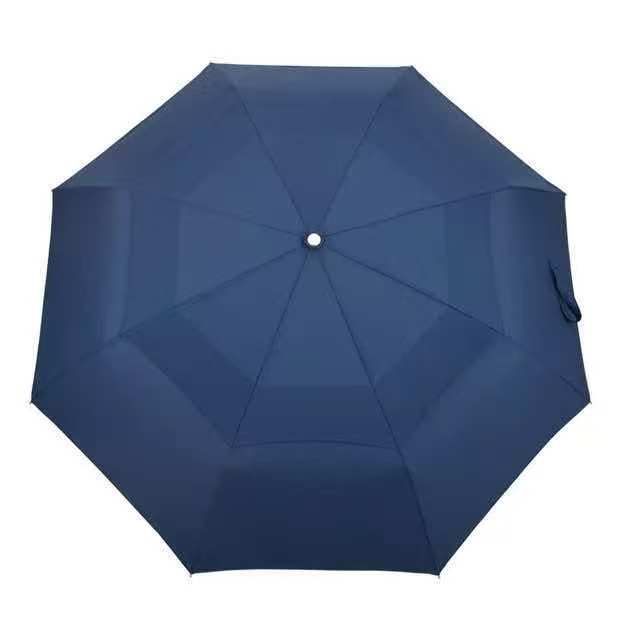
The three supplied images illustrate product appearance and structure. They are not records of the leakage complaints discussed here, nor evidence of a tested rain-resistance or wind-resistance rating. No test report, certification or quantified performance grade is claimed in this article.
“An umbrella is supposed to keep the rain off. Why is water dripping through it?” Over the years, I have received this kind of customer feedback. The question is reasonable: if a buyer orders umbrellas for rain protection, visible leakage deserves an explanation and a practical response.
Fabric and stitched seams can present a seepage risk, but that is not a reason to accept obvious leakage without investigating it.
Where Is the Water Actually Coming From?
Water passing through the fabric
Different canopy fabrics and finishing processes can behave differently in rain. A suitable water-repellent finish encourages droplets to bead and roll away, reducing the time water remains on the surface. However, surface water repellency and resistance to water penetration are not the same property. Buyers need to consider both.
Water passing through stitched seams
Many umbrella canopies are made by sewing separate panels together. Each passage of the needle creates a hole, and those holes can become paths for water. On some black-coated umbrellas, holding the open canopy toward a bright light reveals tiny points of light at the seams.
Seeing a pinhole does not prove that the umbrella leaks. It identifies an area worth checking. Hole size, the relationship between needle and thread, and the consistency of the sewing all matter.
Sideways rain and local water accumulation
We also check the canopy shape, how evenly it is tensioned and whether water tends to collect in one area. If a customer reports water beneath the canopy, establish whether it passed through the material or seams, or was blown underneath from the side. The solution depends on the actual route taken by the water.
What Changes When We Use No. 10, No. 9 or No. 8 Needles?
Needle selection is easy to overlook when buying umbrellas, but it affects everyday production. In the production situations we have encountered, No. 12 is one common canopy-sewing choice. Our regular production uses No. 10; higher-requirement work may use No. 9; some demanding Japanese-customer orders have used No. 8. This is a description of our experience, not a survey of every factory.
| Needle number | Context in our experience | Important boundary |
|---|---|---|
| No. 12 | A common choice among production situations we have encountered. | Not a universal industry requirement. |
| No. 10 | Our regular canopy-sewing choice. | Still requires a suitable fabric, thread and setup. |
| No. 9 | Used for work with higher requirements. | A finer needle alone does not establish rain performance. |
| No. 8 | Used on some demanding Japanese-customer orders. | Not a rule for every Japanese order; requires careful matching and production support. |
Within the same needle system we use, a smaller number means a finer needle and a smaller puncture. Thread must be selected again to suit that needle and the material. In these fine-needle applications, we also use finer thread. Do not convert these numbers into another supplier’s needle system without confirming the actual specification.
Why can finer needles and thread slow production?
In our workshop experience, these finer combinations are more prone to thread breakage and skipped stitches. Operators must stop and correct the problem, interrupting the normal sewing rhythm. Output can fall substantially, especially on the demanding work that uses No. 8 needles.
Machine-maintenance technicians need to stay involved: checking the needle–thread match, adjusting sewing machines and responding to skipped stitches, broken thread and equipment issues. Stable sewing depends on the operators and technical support as well as the selected components.
The buyer sees a smaller needle hole; the factory must allow for slower sewing, more setup time and continuing skilled support.
A finer needle is therefore a production decision, not a simple upgrade that can be specified independently of cost or delivery time. For the separate issue of seam stitch density, see our guide to umbrella canopy stitches. Needle size and the number of stitches along a seam are different specifications.
How Should Fabric, Thread and Sewing Work Together?
Changing a needle cannot solve every leakage problem. For the Japanese-customer orders in our experience, we consider fabric, thread and sewing as a coordinated system.
Choose appropriate water-repellent fabric
A suitable finish helps water form droplets and run off the canopy. But do not assess a fabric only by how quickly a few droplets slide away. Its resistance to water passing through it also matters. Ultimately, we need to check the fabric after it has been made into an umbrella. Our nylon, polyester and pongee fabric guide explains other material-selection considerations.
Consider water-repellent sewing thread
Thread treated for water repellency can help reduce water absorption and water carried along the thread, which may improve the seam’s rain performance. It still has to suit the needle, fabric and machine settings. Changing the thread does not establish that the whole umbrella is leakproof.
Evaluate water-swelling thread where appropriate
Another option is suitable thread that swells when wet. Expansion can help reduce gaps around the needle holes and lower the risk of seepage. The result depends on the selected fabric, needle and sewing conditions. It must be verified on samples, rather than treated as an unconditional guarantee.
For us, better-quality production means making these details work together and checking the finished result. It does not mean choosing one material label and assuming that all the other decisions have been solved.
Can a Double Canopy Reduce Leakage?
A double-canopy design is another option to consider. Sensible positioning of the two layers’ seams and drainage paths can help reduce opportunities for water to drip directly into the space below. But adding a second layer also affects weight, packed volume and production cost.
The choice should follow the intended use. Does the buyer prioritize a light, compact umbrella, or accept extra weight and cost for a different rain-protection design? The proposed construction still needs to be checked on a complete sample.
What Should Buyers and Factories Check When an Umbrella Leaks?
This table helps organize an investigation. It is not a substitute for testing or an agreed acceptance standard.
| Observation | Check first | Do not assume |
|---|---|---|
| Water passes through a fabric panel. | Fabric condition, finishing and resistance to water penetration. | Beading on the surface proves the fabric cannot leak. |
| Drops appear close to a seam. | Needle holes, thread compatibility, skipped stitches and sewing quality. | A particular needle number guarantees the result. |
| Light is visible through seams in a black-coated canopy. | The seam and whether water actually penetrates at the corresponding location. | A point of light is itself evidence of leakage. |
| Rain enters from the canopy edge. | Wind direction, holding angle and coverage. | Sideways rain is necessarily fabric seepage. |
| Water collects in a local area. | Canopy shape, tension and drainage paths. | A structural adjustment works without checking the finished umbrella. |
When reporting a problem, note the location and conditions and provide photos or video where possible. The factory should inspect the actual product before deciding whether to change the fabric, needle and thread, sewing or structure. It should not dismiss an unexplained complaint by saying that “needle holes are normal.”
Why Can Similar Umbrellas Have Different Production Costs?
Buyers can easily see the fabric, frame, handle and printing. They rarely see which needle and thread were used, how often a sewing machine needed adjustment, or how much technician time supported production. Those less-visible details still cost money.
Different needle–thread combinations can produce very different sewing speeds. Tighter requirements for needle holes and seam consistency may call for more setup, equipment maintenance and inspection. Our work on demanding Japanese-customer orders reinforced the importance of matching quality expectations with practical production management.
This does not mean a lower-priced umbrella must leak, or that a more expensive umbrella has necessarily been made correctly. The relevant questions are what requirements it was made to, which materials and processes were used, and how the finished product is accepted.
Agreeing on rain performance, weight, budget and acceptance conditions before production is more useful than comparing unit price alone.
What Should Be Confirmed Before Ordering?
- Intended use: explain whether the umbrella is for commuting, hotel service or corporate gifting, and set expectations for weight and packed size.
- Materials and construction: confirm the fabric, number of canopy layers and relevant finishing. Do not treat “black coating,” “water-repellent” or “double canopy” as proof against leakage.
- Needle, thread and sewing: agree on a compatible combination, including the needle specification system, rather than imposing one number on every product.
- Sample verification: inspect the complete sample’s panels and seams. A fabric droplet demonstration or a photograph taken against the light is not enough.
- Acceptance arrangements: agree on inspection items, test conditions and pass/fail criteria before production. Follow the confirmed requirements rather than inventing a performance standard after delivery.
For related production checks and the limits of sampling versus full inspection, see our seven umbrella quality-control points from Japanese-client inspection experience.
Frequently Asked Questions
Do needle holes mean an umbrella will leak?
Not necessarily. Needle holes can be a route for water, but the result also depends on the fabric, needle–thread match and sewing quality. Light visible through a seam is an inspection clue, not a leakage test result. Check the completed umbrella under agreed conditions.
Is a No. 8 needle always better than a No. 12 needle?
No. These numbers refer to the needle specification system used in our production experience, not a universal international scale or stitch density. A finer needle may make a smaller hole, but it needs compatible thread, suitable machine settings and stable sewing. The finished result matters more than the number alone.
Is water-repellent fabric the same as a completely leakproof umbrella?
No. Water repellency describes how water wets, beads on and runs off the surface. Resistance to water passing through the fabric and seams must be assessed separately. A water-beading demonstration does not establish the rain performance of a completed umbrella.
Can water-swelling sewing thread guarantee dry seams?
No. Suitable water-swelling thread can expand when wet and help reduce gaps around needle holes. Its usefulness depends on the fabric, needle and sewing conditions, and must be checked on samples. It is an option to evaluate, not a blanket leakproof guarantee.
Does a double canopy always provide better rain protection?
No. The outcome depends on seam positions, overlap and drainage paths, and needs finished-product testing. Double-canopy designs also involve weight, packed size and cost trade-offs. An overlapping vented canopy is one design, not the definition of every double-layer umbrella.
Does a higher umbrella price guarantee that it will not leak?
No. A higher price is not a substitute for confirmed materials, workmanship and acceptance results. Buyers should compare the actual production specification, approved sample and agreed inspection conditions instead of assuming that cheap umbrellas always leak or expensive umbrellas never do.
Conclusion: Investigate the Cause, Then Confirm the Finished Result
An umbrella looks simple, but dependable rain protection comes from coordinated production details. Our experience with No. 10, No. 9 and No. 8 needles, compatible thread and hands-on machine adjustment shows why quality requirements can affect output and labour cost. Fabric selection, special sewing thread and double-canopy construction each have possible benefits and limits.
If you are developing a quality-sensitive umbrella, discuss your intended use, specifications and budget with our umbrella team. We can review fabric, sewing and construction options, then use sampling to establish what works for the proposed product.