
DIGITAL PRINTING & COLOR CONTROL
By Aihua Chen | Hand in Hand Umbrella Factory
Quick answer: Three approaches can be considered for color bleeding or color transfer on digitally printed umbrellas: washing the canopy fabric, printing before applying the waterproof coating, and treating the printed fabric in rolls before cutting. In our processing experience, canopy washing has cost approximately RMB 0.8–1.5 per quoted piece, while roll treatment has cost approximately RMB 0.7–0.8 per linear yard. These are different billing units—not directly comparable per-umbrella prices. Choose a process by production stage and approve samples made with the actual fabric and artwork.
Reducing unwanted color transfer is only part of the task. A treatment can also make a vivid design look dull or gray. Based on more than a decade of printing experience, our priority is to compare color-transfer improvement, final appearance and the practical production sequence together. None of the methods below is a universal remedy for every fabric, coating or finished umbrella.
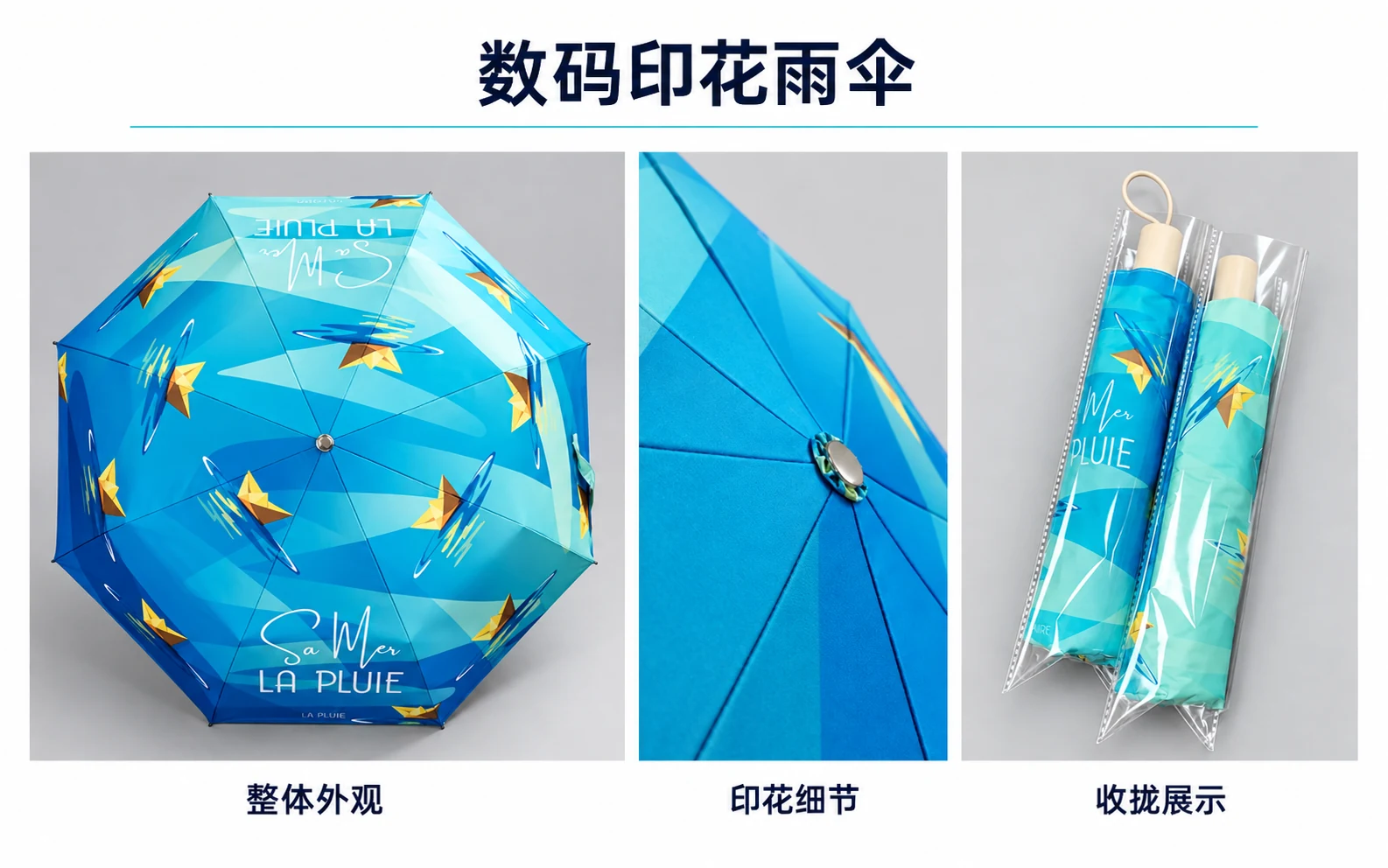
First, identify when and where the color transfer occurs
Buyers may use “color bleeding,” “color transfer” or “color migration” to describe different visible problems. Do not assume that every shade difference has the same cause, or diagnose the mechanism from one photograph.
- Was the problem visible immediately after printing, or only after cutting, sewing, folding or storage?
- Where does it appear? Were dark and light areas touching, and was the fabric wet or dry?
- Is the material still in rolls, already cut into panels, sewn into canopies or assembled into finished umbrellas?
These details determine which options remain practical. Changing the printing/coating order is a production-planning decision. Roll treatment belongs before cutting; it cannot simply be applied to a completed umbrella using the same workflow.
Three treatment approaches: stage, cost and trade-offs
| Approach | When and how | Processing-cost reference | Main trade-off |
|---|---|---|---|
| Canopy washing | Wash the canopy material; confirm the exact processing state and handling method with the processor. | About RMB 0.8–1.5 per quoted piece, often around RMB 1. | Some dark or vivid designs can become duller or grayer. |
| Print first, coat afterwards | Plan digital transfer printing onto uncoated base fabric, followed by the waterproof-coating process. | Quoted for the actual process; no fixed reference price. | Printing and coating must be coordinated in advance. This is not a general finished-product repair. |
| Treat the printed fabric in rolls | After printing and before cutting: specialist soaking, drying and setting. | About RMB 0.7–0.8 per linear yard. | Requires specialist processing and sample validation for the selected fabric, coating and artwork. |
Cost scope: These figures are examples from processing work we have encountered, not current fixed quotations or complete umbrella prices. Confirm exactly what one “piece” means in the processor’s quote. It must not automatically be interpreted as one triangular panel, one complete canopy or one finished umbrella. Compare costs only after aligning the billing basis, finished quantity and included operations.
Method 1: canopy washing—check for loss of color vibrancy
Canopy washing is a relatively common approach in the production work we have encountered. It can improve some color-transfer problems, but may also change the appearance of the print. Certain dark or highly saturated designs become less vivid, duller or grayer after treatment.
Keep an untreated reference sample. Compare it with the treated sample for both unwanted color transfer and overall visual quality. A reduction in bleeding is not enough if the customer no longer accepts the design’s brightness or contrast.
Our processing-cost references range from approximately RMB 0.8 to RMB 1.5 per quoted piece, often around RMB 1, depending on quantity, canopy size and processing requirements. For sewn canopies or assembled umbrellas, ask whether treatment is feasible and whether disassembly or other work would be necessary. Do not reuse a roll-processing quote for finished products.
Method 2: digital transfer printing before the waterproof coating
This approach changes the order of operations: the base fabric is digitally transfer-printed before the waterproof coating is applied. We have encountered it less frequently than canopy washing, but it can be considered during production planning.
The printing and coating stages need to be coordinated around the actual fabric and finishing specification. Use the order’s real fabric and artwork for a trial, then confirm the final appearance and the required water-resistance performance separately.
This is a process-design option, not a universal repair for umbrellas that have already been made. Changing the sequence alone does not establish that color bleeding has been solved or that all performance requirements have been met.
Method 3: treat the printed fabric in rolls before cutting
This is the approach with which we have accumulated more practical experience. After digital printing, the fabric is sent to a specialist textile processor while it is still in roll form.
Printing → specialist treatment bath → drying → setting → cutting and subsequent canopy production.
Under suitable fabric and processing conditions, our experience has been that this method can reduce unwanted color transfer while retaining much of the print’s vibrancy. It is worth sampling when both color control and a vivid design matter. This experience does not establish suitability for every coating, material or artwork, and it is not a promise of zero color transfer.
How should buyers calculate the added cost?
The processing rates we have encountered are approximately RMB 0.7–0.8 per linear yard. A practical allocation formula is:
Roll-treatment cost per finished umbrella = actual billed yardage × processing rate per yard ÷ corresponding finished-umbrella quantity.
Confirm fabric width, material consumption, cutting layout and waste when establishing billed yardage. Ask about minimum processing quantities and the operations included in the quote. The formula covers this treatment step only—not the full cost of fabric, printing, assembly, packing or delivery.
Why does specialist processing matter?
The method needs suitable textile-washing, drying and setting capabilities, as well as experience with the selected fabric. We draw on specialist apparel and textile-processing services for this step and coordinate treatment with printing and subsequent cutting.
The treatment-bath formulation and processing parameters belong to the specialist processor’s process knowledge. We do not publish a chemical recipe or recommend unverified do-it-yourself mixtures. For buyers, the useful evidence is a comparison of the actual fabric and artwork before and after treatment.
What should be checked before approving bulk production?
- Color transfer: compare untreated and treated samples from the same fabric batch and artwork under the use or storage conditions agreed for the order.
- Appearance: check brightness, contrast, fine detail and overall color. An improvement in bleeding must not hide unacceptable dulling.
- Other performance requirements: agree the relevant water-resistance, water-repellency or colorfastness tests, conditions and acceptance criteria separately. Bright color is not proof of these properties.
- Commercial scope: confirm production stage, billing unit, quantity, included operations and allocated cost per finished umbrella.
Retain the approved physical samples and process records. “Washed” or “treated” is a description of a step, not evidence that the finished order meets its requirements.
Frequently asked questions
Will washing always make an umbrella print dull?
No. Some dark or vivid designs have become duller or grayer in our processing experience, but the effect is not universal. Compare actual untreated and treated samples before deciding.
Can roll treatment guarantee that colors will never bleed?
No. Results depend on the fabric, coating, artwork and processing conditions. Previous experience cannot replace sampling and validation for the current order.
Can a sewn canopy use the same roll-treatment process?
Not directly. The roll-treatment workflow described here takes place after printing and before cutting. For sewn canopies or completed umbrellas, first confirm the product’s condition and discuss a feasible treatment with the processor.
Is a per-yard quote cheaper than a per-piece quote?
Not necessarily. Clarify the meaning of “piece,” then compare the billed quantities, included work and corresponding finished-umbrella quantity. A lower numerical rate does not automatically mean a lower cost per umbrella.
Which approach should be sampled for a vivid design?
Roll treatment after printing and before cutting is worth comparing because we have experience balancing reduced color transfer with retained vibrancy. It still needs validation on the actual order materials and artwork.
What information is needed for a treatment recommendation?
Send the fabric and coating details, artwork, problem photographs, when and under what conditions the issue appeared, the current production stage, order quantity and color requirements. Identify any unknown details so they can be checked before a process is agreed.
Plan the sample before choosing the production method
Hand in Hand Umbrella Factory has accumulated more than a decade of printing-process experience. Our practical recommendation is to approve the sample result first, then choose the bulk-processing route. Business coordination is in Guangzhou, and our production base is in Taoyuan Town, Heshan, Jiangmen, Guangdong.
For the wider process decision, read our comparison of four umbrella printing methods. For other print-development issues, see cross-seam pattern matching and fabric color sampling and coatings.
Discuss your fabric, artwork and color-transfer sample with our team.