Fabric sourcing & color approval
By Aihua Chen | Hand in Hand Umbrella Factory
For custom umbrella fabric, confirm the material and final coating before approving the color. Use stock fabric when its actual shade meets the brief; consider custom dyeing when it does not. If a silver coating or another finish is added after sampling, recheck the color on the finished fabric. Bulk production and repeat orders should be judged against an agreed sample and acceptance criteria, not a color name alone.
This guide focuses on custom color approval. For a broader material comparison, see nylon vs. polyester vs. pongee umbrella fabric.
Why did a US umbrella order need two rounds of fabric samples?
In a US customer project handled by our factory, the original specification was solid gray nylon without a silver backing. We prepared fabric samples against that requirement. The customer later added a sun-protection coating requirement, and a silver-coated solution was selected.
After the coating was added, the gray nylon looked different. The uncoated sample could no longer represent the final fabric, so we arranged a second round of sampling and approval. This extended the schedule. The first sample was not a mistake: the specification had changed.
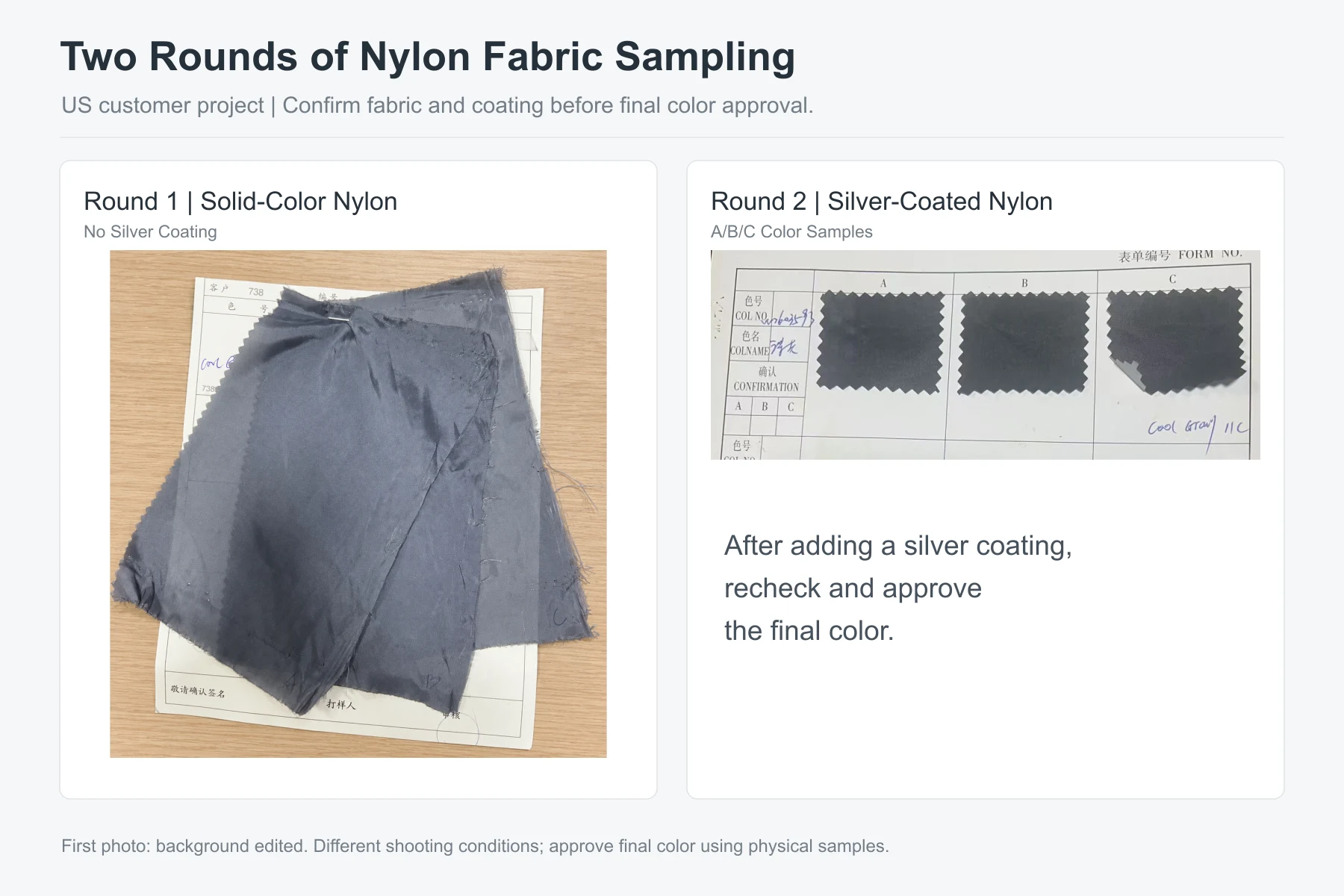
The lesson: color approval must match the final production process. Changing the material, coating or finish means reviewing whether the earlier approval still applies. Sun-protection performance must be confirmed separately; an approved color is not a performance test.
1. Specify the fabric, coating and printing together
Before choosing a shade, explain the umbrella’s use, target weight, handle of the fabric, artwork and performance requirements. Trade names alone do not define a complete fabric specification.
- Fabric: confirm fiber composition, construction, weight and the feel of an actual sample.
- Coating: specify whether silver, black or another backing or finish is required.
- Printing: distinguish a small logo from full-panel or all-over artwork, and agree the process.
Silver coating is a material treatment, not proof of a particular UV-protection rating. Agree the required performance and supporting test evidence for the final construction.
2. Choose stock fabric, printing or custom dyeing
| Option | When to consider it | What to confirm |
|---|---|---|
| Stock-color fabric | An available physical shade meets the buyer’s requirement. | Available quantity, batch consistency and the repeat-order reference. |
| Printed fabric | Patterns, full-panel artwork or a print-based color solution are needed. | Fabric and ink compatibility, artwork, appearance, feel and cost. |
| Custom-dyed fabric | Available stock colors cannot meet the agreed target. | Minimum dyeing quantity, lab-dip approval, acceptable bulk variation and timing. |
Custom dyeing and printing are different production routes. Do not decide only by a rule such as “print small orders, dye large orders.” Compare the actual material, quantity, appearance, included work and delivery schedule.
Conventional dye sublimation normally uses suitable white or light-colored polyester fabric. It should not automatically be specified for nylon or an already-coated fabric. Epson’s digital textile printing primer explains why fabric selection matters. Confirm the proposed fabric, ink and process as a combination.
3. Use a complete color reference, not a screen image
Send the full color code, its reference system or color-book type, and preferably a physical reference. A screenshot can communicate a direction, but it is not a reliable physical acceptance standard. Pantone’s physical-sample guidance notes that screen simulations can differ from physical standards.
The canopy’s base color and the logo’s spot color are separate approvals. Approving the fabric does not automatically approve logo color, opacity or print quality.
4. What should a custom-color lab dip confirm?
A lab dip is a small dyed fabric sample used to assess the proposed shade before bulk dyeing. In our projects, samples have ranged from very small swatches to larger pieces, sometimes with several alternatives labeled A, B, C or D. These are project examples, not a fixed sample size or a universal number of choices.
A small swatch helps confirm color. If the buyer also needs to assess coating appearance, fabric feel, printing or the assembled canopy, request a finished-process sample or a complete umbrella sample through the sample approval process.
Record the selected sample ID and approval date, fabric specification, final coating, reference standard, comparison method and acceptable tolerance. Buyer and supplier should retain matching approved physical samples for production and repeat orders.
5. Agree how shade variation will be assessed
- Reference: state whether the target is a supplied color standard or the mutually approved finished-fabric sample.
- Viewing conditions: agree lighting, fabric face and sample presentation. Compare like with like, not a phone image against fabric or an uncoated sample against a coated product.
- Acceptance criteria: if instruments are used, specify the measurement conditions, color-difference method and tolerance before production.
X-Rite’s textile color-management guidance covers color specifications, tolerances, illuminants and lab-dip evaluation. Our practical advice is to agree an order-specific method rather than impose one universal color-difference number on every fabric and finish.
6. Check dye lots, fabric rolls and repeat orders
The same stock-color name does not guarantee an identical shade in a later purchase. For example, a repeat order using “yellow” fabric may look different from the first order if dyeing or finishing conditions differ. Keep the previous fabric sample and specification, then compare the new batch before production.
A single order may also use fabric from several dye lots. Track lots and rolls, inspect their shades, and plan cutting and panel joining so that visibly mismatched fabric is not combined on one umbrella. Where practicable, use matching fabric from the same dye lot within each canopy.
Same-lot fabric still needs inspection. Check uniformity within the fabric, consistency between rolls and the appearance of the assembled canopy. “Different batch” may help explain a problem, but does not automatically make it acceptable. The approved sample and agreed criteria determine acceptance.
Buyer checklist: what to send before sampling
- Umbrella application, styles and quantity per color.
- Fabric composition, construction, weight and desired feel, or a request for recommendations.
- Complete color reference and physical target sample where available.
- Final coating and finishing requirements, plus logo or full-panel artwork.
- Performance requirements and the evidence needed to verify them.
- Required approval stages: lab dip, finished-fabric sample and/or complete umbrella.
- Color acceptance method, permitted variation and required delivery date.
Providing these details cannot guarantee one-round approval, but it can reduce avoidable resampling. Use our custom umbrella quotation checklist to prepare the wider order brief.
Frequently asked questions
Does a Pantone code mean custom dyeing is necessary?
No. First compare physical stock-fabric samples with the target. Custom dyeing is an option when available shades do not meet the agreed requirement.
Will silver coating always change the fabric color?
Not necessarily. The gray nylon in this US project changed in appearance after silver coating. Other materials must be checked in their final construction; this case does not establish a universal color shift.
Can custom dyeing guarantee zero difference between batches?
No. Agree a reference sample, evaluation conditions and acceptable tolerance, then check production and repeat batches against them.
Is a small color swatch enough to approve an umbrella?
Not when the buyer also needs to confirm overall canopy appearance, coating, feel or printing. A swatch and a complete umbrella sample answer different questions.
How can repeat orders avoid color disputes?
Retain approved samples and material and process records. Check the new batch before production instead of relying only on the original color name.
Discuss your custom umbrella fabric requirements
Send your quantity, fabric preference, color reference, coating, artwork and delivery target to Hand in Hand Umbrella Factory. We can assess a practical sampling route before bulk production. Discuss your project on WhatsApp.
About the author: Aihua Chen represents Hand in Hand Umbrella Factory, with business coordination in Guangzhou and our production base in Taoyuan Town, Heshan, Jiangmen, Guangdong.