
By Aihua Chen | Hand in Hand Umbrella Factory
3D printing can help umbrella development by making handle shapes, decorative details and assembly ideas easier to evaluate before production tooling. Its immediate value is usually in prototyping—not in replacing every mass-production process. Material selection, fit, durability, finishing and total cost still need to be checked on the actual design.
After an invitation to TCT Shenzhen 2026, I spent about two hours looking at materials, printed samples, machining equipment and development tools. The visit gave me new ideas for umbrella handles and accessories, but also reinforced an important distinction: an attractive display sample is a starting point for development, not a production-ready umbrella component.
What did the TCT Shenzhen visit contribute?
The official event schedule lists TCT Shenzhen 2026 for October 14–16 at Shenzhen World Exhibition & Convention Center, Bao’an, Hall 15. Source: TCT’s official event announcement.
My short visit focused on what might help a real umbrella project: colored and transparent resin, metal printing, small CNC machines, mold-related ideas and easier modeling tools. I collected material information and supplier contacts for further investigation. These observations should not be read as a claim that every process is already used in our umbrella production.
Which process might suit which development task?
| Process | Potential umbrella application | What still needs confirmation |
|---|---|---|
| Resin 3D printing | Handle form, decorative detail and transparent or colored appearance studies | Resin grade, finishing, fit and suitability for the intended conditions |
| Metal 3D printing | Special-shaped accessories and metal design prototypes | Weight, surface finish, assembly, post-processing and unit cost |
| CNC wood machining | Wooden handle curves, grip shapes and connection details | Wood selection, machining access, dimensions, finish and repeatability |
| Printed mold components or inserts | Selected trial-tooling concepts | Compatibility with the mold, operating conditions, service life and overall economics |
1. Resin samples: explore appearance without assuming performance
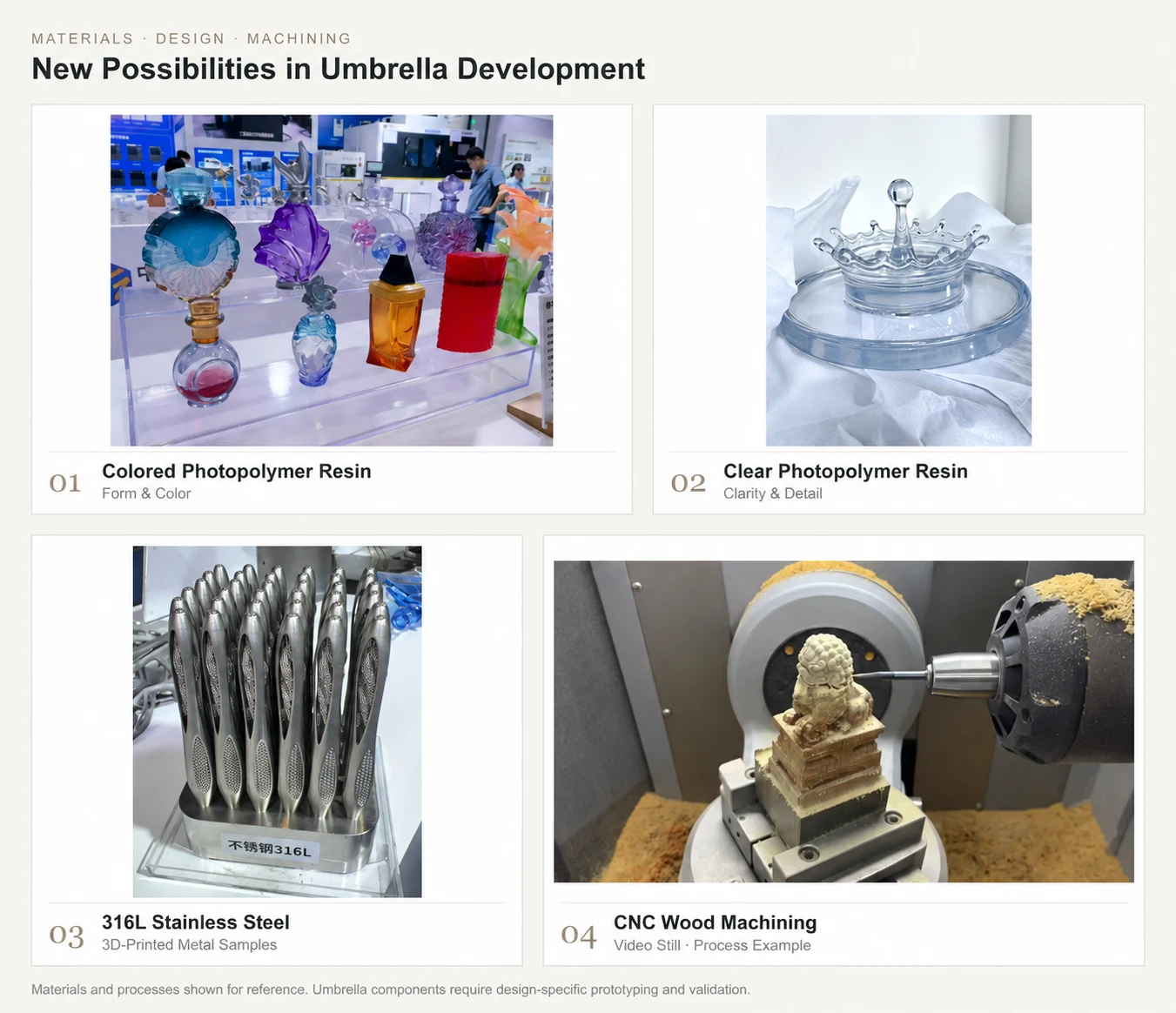
Some colored and clear photopolymer resin displays were especially striking. With post-processing and polishing, certain pieces had an appearance reminiscent of acrylic. That is an appearance comparison—not a statement that the materials are equivalent.
For an umbrella project, this suggests possibilities such as a transparent handle, a colored decorative element or a distinctive surface detail. Before progressing, the buyer and developer should agree whether the sample is for appearance only, for assembly checking or for functional evaluation. The same sample may not serve all three purposes.
Confirm the exact material and finish, the connection to the shaft, the intended handling conditions and the checks required before approval. A visually convincing prototype should not automatically become the approved specification for bulk production.
2. Metal printing: useful ideas for special shapes, with cost checks
The metal displays included stainless steel, aluminum and copper examples. A fine stainless-steel display sample and the finish on another ornament caught my attention because they related to a look we were considering in an ongoing development project.
The useful takeaway was a new route to investigate for unusual forms and metal details—not a promise that metal printing would be the cheapest solution. For an umbrella accessory, the quotation should separate printing, support removal where applicable, finishing and any additional machining. Weight and the connection to the rest of the umbrella also matter.
For larger quantities, compare the proposed printed route with other suitable manufacturing methods. A process that is helpful for one prototype may not be the right commercial choice for a repeated production order.
3. CNC wood machining: a separate route for handle development
The machining equipment also prompted ideas about wooden handles: curves, grip profiles and connection details can all affect the final user experience. Multi-axis machining may help with selected shapes, subject to the design and supplier’s assessment.
CNC machining is not 3D printing. CNC removes material from a workpiece, whereas 3D printing builds a part additively. The wood-machining image above is a process reference, not evidence that the displayed object was printed or that it is an umbrella part.
When comparing a wooden handle prototype with a resin appearance model, be clear about the question each one answers. A resin model can help discuss shape; the intended wood, surface treatment and actual assembly must still be evaluated separately.
4. Printed tooling and easier modeling: possibilities, not guaranteed savings
Another idea was to combine selected printed mold components or inserts with a mold base for trial work. It may be worth exploring for a suitable project, but it is not a universal low-cost replacement for conventional tooling. The part design, insert material, molding conditions and required service life determine whether the idea is practical.
Likewise, easier modeling tools may speed up the discussion of design variants. They do not remove the need to check dimensions, assembly interfaces and structural details. The CAD model must match the actual umbrella shaft, frame and intended production process.
I would not quote a fixed saving, tooling life or development time from a display alone. Those figures need a project-specific assessment and quotation. For the distinction between digital design, prototypes and tooling, see our umbrella prototype, 3D modeling and tooling guide.
What should buyers confirm before paying for a prototype?
Some of the printing and machining quotations discussed were not inexpensive. The better question is not simply “Can this be printed?” but “What decision will this sample help us make?”
- Define the sample’s purpose: appearance, grip, assembly fit or functional testing.
- Provide the interface: drawings, dimensions and the relevant shaft or frame sample.
- Specify material and finish: distinguish the prototype material from the intended production material.
- Set approval criteria: agree what will be measured or checked and what the sample cannot demonstrate.
- Separate charges: modeling, revisions, printing or machining, finishing, tooling and delivery.
- Compare the production route: discuss expected order volume and whether the prototype process will change for bulk manufacture.
Our practical approach is to use a prototype to reduce uncertainty before making a larger commitment. For related project considerations, read custom umbrella handle prototyping and small-batch production.
Frequently asked questions
Can 3D printing help develop a custom umbrella handle?
Yes. It can help assess shape, grip and assembly fit before committing to production tooling. A printed appearance sample is not proof that the final handle will meet strength or durability requirements.
Does a clear resin sample perform like acrylic?
Not necessarily. Similar appearance does not establish the same material properties. Confirm the resin grade, post-processing and intended use, then validate a physical sample.
Is CNC wood machining a type of 3D printing?
No. CNC machining removes material from a workpiece; 3D printing builds a part additively. Both can be useful in development, but they use different processes and cost structures.
Will printed mold inserts always reduce tooling costs?
No. Suitability depends on the part, insert material, molding conditions and required service life. Compare a project-specific trial-tooling quote with conventional tooling before deciding.
What should a buyer provide for a prototype quotation?
Provide drawings or CAD files, key dimensions, the umbrella frame or shaft interface, material and finish targets, sample quantity, intended tests and expected production volume. Separate design, printing, finishing, tooling and delivery charges.
Discuss an umbrella development idea
Hand in Hand Umbrella Factory coordinates business in Guangzhou, with our production base in Taoyuan, Heshan, Jiangmen, Guangdong. If you are developing a custom handle or accessory, send your drawings, target appearance, intended use and estimated order quantity. We can discuss which questions need a prototype and which require further supplier or production assessment.
Contact us about your umbrella project or review our custom umbrella order process.