
Direct Answer: Can an Umbrella Have Different Colors Inside and Outside?
Yes. An umbrella can have one color outside and another inside, or separate all-over designs on its two sides. Options include double-sided printing on a single fabric, two separate canopy layers, and fabric-to-fabric lamination. The main challenge with single-layer double-sided umbrella printing is controlling how the colors affect each other, particularly when one side is light and the other dark. Creating two different colors is not the same as accurately matching two specified colors. Buyers should confirm the fabric construction, both designs and acceptable color variation, then approve physical samples of both sides and the finished umbrella.
Case Scope and Evidence Boundaries
This guide draws on our work at Hand in Hand Umbrella, including a Shenzhen hotel order requiring yellow outside, blue inside and a single-layer canopy. We compared digital dye-sublimation transfer and direct-to-fabric printed samples on 300T pongee. The observations below concern that particular fabric, color combination and processing conditions, not a universal verdict on either printing method. No order quantity, delivery result, certification, UV rating or quantified color-tolerance result is claimed. Fabric-to-fabric lamination is discussed separately as a development direction, not as the method used for this hotel order.
What Does Double-Sided All-Over Umbrella Printing Mean?
It means creating separate designs on the two faces of the canopy fabric so that the open umbrella presents its own color or pattern both outside and inside. We are discussing the appearance across the entire canopy, not simply a logo printed on one panel. Examples include a fully yellow exterior with a dark-blue interior, or a brand pattern outside and a different decorative design inside.
Double-sided printing describes the printing process; a double canopy describes the material construction. Double-sided printing does not necessarily require two fabrics. Equally, using two canopy layers does not necessarily mean that either fabric is printed on both faces. When requesting a “double-sided umbrella,” explain both the required appearance and whether one or two fabric layers are acceptable.
Why Is a Pattern Visible Inside Not Necessarily Double-Sided Printing?
On a relatively thin canopy, an outside print can show through to the reverse. The same pattern may therefore be visible from inside even though only one face was printed. This is different from separately printing the inner face.
In our production experience, the distinction is particularly noticeable with large areas of solid color. When only the outside is printed and there is no black or silver coating inside, the exterior may look vivid while the interior remains whitish, with only a faint impression of the outer color. For a buyer expecting a rich, complete inner color, that appearance may not meet the intended finish.
Seeing the outside color through the fabric is not the same as having an independently colored, uniform inner surface.
Silver, black and colored coatings can create different interior appearances, and we have worked with several colored-coating fabrics. However, a specified inside/outside color pair or two independent all-over designs needs a processing route suited to those particular requirements.
Which Construction and Printing Options Can Buyers Consider?
| Option | How it works | Main checks |
|---|---|---|
| Single fabric, double-sided dye-sublimation transfer | Transfer separate designs onto both faces of the same fabric, retaining a single-layer construction. | Interaction between the colors, color accuracy and uniformity on both sides. |
| Single fabric, double-sided direct-to-fabric digital printing | Print directly onto both faces. The complete workflow depends on the processor. | Show-through, any visible graininess and the actual sample appearance. |
| Conventional two-layer canopy | Use separate inner and outer fabrics, with their designs produced independently. | Added weight, folded bulk and how easily the layers can be arranged neatly. |
| Fabric-to-fabric lamination | Bond two fabrics closely into a composite; another possible route for different inner and outer designs. | Hand feel, weight, folding behavior and color appearance after lamination. |
Transfer and direct printing are printing methods. Two-layer construction and lamination are material-combination methods. They are not four mutually exclusive categories: the printing process and the canopy structure must be specified together. For the wider choice of processes, see our comparison of four umbrella printing methods.
Shenzhen Hotel Case: Yellow Outside, Blue Inside, One Fabric Layer
| Customer context | A hotel in Shenzhen, China |
|---|---|
| Required appearance | Yellow exterior and blue interior |
| Required construction | Single-layer canopy fabric |
| Fabric selected | 300T pongee; 300T is the fabric density designation, not 300D yarn denier |
| Sample comparison | Digital dye-sublimation transfer versus direct-to-fabric digital printing |
| Main difficulty observed | The two sides influenced each other’s color appearance |
| Method selected for this order | Digital dye-sublimation transfer printing |
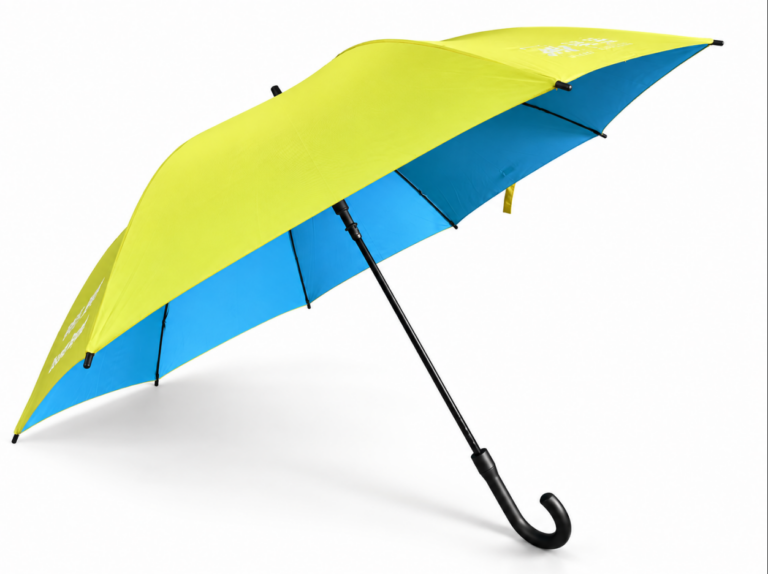
What happened to the two colors during sampling?
We selected 300T pongee and tried yellow on one face and dark blue on the other. The transfer-printed sample did show two different colors, but those colors did not appear completely independent. In that sample, yellow affected the purity of the blue, while blue also influenced the appearance of the yellow.
“Color interference” here describes the visual result we observed. It should not be interpreted as a confirmed chemical reaction between the two colors.
On a single-layer canopy, “producing two colors” and “accurately reproducing two specified colors” are different acceptance requirements.
Under the material and processing conditions of that project, very strict matching on both sides was difficult. Where the customer could accept some adjustment, the practical approach was to discuss and approve the appearance using physical samples. We are continuing to try lighter color combinations to see whether interference can be reduced; this remains subject to actual sample results, not a validated solution for every design.
Why did this order use dye-sublimation transfer printing?
We also asked a direct-to-fabric digital printing processor to prepare samples. That processor could print both faces and perform preliminary cutting into long strips for subsequent production.
The direct-printed sample also showed interaction between the two colors, together with slight graininess in the printed areas. In our comparison, the transfer-printed sample looked more uniform and better suited this order’s appearance requirements. The hotel order therefore used digital dye-sublimation transfer printing.
This was a comparison of particular samples. It does not mean that all direct-to-fabric printing is grainy, or that transfer printing is best for every double-sided umbrella. The decision should follow the intended product’s sample, not the process name alone. A separate hotel brand-color sampling case explains another situation where the full-umbrella sample was important to color approval.
How Do Dye-Sublimation Transfer and Direct-to-Fabric Printing Differ?
Digital dye-sublimation transfer printing generally prints the design onto transfer paper first, then uses heat to transfer the dye into a suitable fabric. Direct-to-fabric digital printing deposits the print directly onto the textile. The route selected for our hotel order is therefore described as dye-sublimation transfer printing, not direct printing.
However, “direct-to-fabric” does not identify the entire ink system or post-printing workflow. Dye sublimation can also use a direct-to-textile route followed by heat treatment. These terms must be used carefully.
For general process definitions, see Epson’s explanation of dye-sublimation transfer and EFI’s discussion of direct-to-textile and transfer-paper routes. These sources explain terminology; they do not validate the performance of our particular umbrella.
Ask a supplier to explain the actual processing sequence and show physical samples using a comparable fabric and color combination. That is more informative than choosing a method from its label alone. Our umbrella fabric guide provides further material-selection context.
Could Fabric-to-Fabric Lamination Make a Two-Layer Canopy Neater?
During a visit to a fabric finishing factory in Jinjiang, we saw a black film being laminated to fabric to create an inner finish. That observation suggested a different possibility: bonding together two canopy fabrics that already carry their own colors or patterns.
A conventional double canopy uses two relatively independent fabrics. Fabric-to-fabric lamination would hold the two materials closely together as a composite. This may reduce the puffiness associated with layers separating and may improve neatness and the experience of arranging the folded canopy.
A laminated fabric still contains two fabric layers. Bonding them closely does not make it a true single-layer fabric or prove that it is lighter.
This idea is separate from the single-layer transfer-printing route used for the Shenzhen hotel order. Whether a laminated construction achieves the required color isolation, hand feel and folding behavior must be established through separate samples. A compact appearance alone does not establish reduced weight or satisfactory performance.
What Should Buyers Confirm Before Sampling?
- Material construction: Is a single fabric layer mandatory, or are separate layers or laminated fabric acceptable?
- Both designs: Provide the exterior and interior colors or complete artwork separately.
- Color requirements: Identify which colors require strict matching and which can be adjusted after sample review.
- Interior appearance: State whether whitish areas or show-through are acceptable, and whether black or silver coatings are excluded.
- Finished-umbrella behavior: Review more than a fabric swatch. Check the open canopy, the folded product and how easily it can be arranged neatly.
Inspect both sides under the same lighting. With strongly contrasting combinations such as yellow and blue, approving one face does not establish that the other face is acceptable. Record the approved appearance and construction together.
Frequently Asked Questions
Can a single-layer umbrella have a different design on each side?
Yes, double-sided printing on a single fabric can be evaluated. Whether it meets the requested appearance depends on the fabric, designs and processing conditions. Our Shenzhen hotel case achieved different colors on the two sides, but also showed color interference. Confirm both sides on physical samples.
Does double-sided printing mean a double-canopy umbrella?
No. Double-sided printing describes printing on the two faces of a fabric. A double canopy describes a construction using two fabric layers. A design showing through from the outside is not proof that the reverse has been printed separately.
Does printing both sides automatically improve UV protection?
No. Printing on both sides does not by itself establish UV performance. This case describes appearance and processing experience and includes no UV test results. Any UV-protection claim needs appropriate evidence for the specified product.
Can the inside have a custom color without black or silver coating?
Double-sided printing or a two-layer canopy can be considered for a specified inner color. First clarify whether the buyer requires a complete, independent color surface rather than a faint view of the outside print. Confirm the selected construction and color combination through sampling.
Does fabric-to-fabric lamination turn two layers into one lightweight fabric?
No. A laminated composite still contains two fabric layers. Bonding them closely does not prove that weight is reduced. The potential benefits concern how the layers hold together, surface neatness and folding; these require separate sample evaluation.
Is dye-sublimation transfer always better than direct-to-fabric printing?
No. In this hotel project, the transfer-printed sample looked more uniform than the direct-printed sample and was selected for the order. That observation does not establish a universal ranking. Compare samples using the intended fabric, color combination and acceptance requirements.
Conclusion: Approve the Appearance and the Construction Together
Different inside and outside colors are possible, but a workable custom umbrella starts with two practical questions: what does the buyer want to see, and what can the proposed material and process achieve? Define the designs, number of fabric layers and acceptance requirements, then compare samples. The hotel project demonstrates why printing two colors is only part of the job: the interaction between those colors also matters.
If you are planning different inner and outer canopy designs, send both designs and your construction requirements to our umbrella team. We can review the material and process options and use sampling to establish a suitable approach.