
Materials & frame selection
Fiberglass vs. Carbon Fiber Umbrella Ribs: Which Should You Choose?
Fiberglass usually offers a cost advantage; carbon fiber can offer lower weight and greater stiffness. Neither material automatically makes a better umbrella. Compare the actual frame design, finished weight, manufacturing quality, intended use and budget—not just the material name.
Before buying, ask: What material is used, in which components, and how has the complete umbrella been tested? If either type breaks, avoid touching or repeatedly bending the broken area with bare hands.
1. Umbrella ribs, shaft and frame are not the same thing
When a buyer asks us for “fiber ribs,” we first clarify the material and the components covered by that description.
- Ribs are the structural members supporting the canopy.
- Shaft means the central pole connected to the handle and opening mechanism.
- Frame usually means an assembly of ribs, shaft and connecting parts. Confirm exactly what the quotation includes.
A fiberglass shaft does not necessarily mean fiberglass ribs. Likewise, a “carbon fiber frame” does not mean every component is carbon fiber.
These parts are generally fiber-reinforced resin composites. Fibers provide reinforcement; the resin holds them together and transfers loads. Fiber content, orientation, resin choice and processing affect the finished component. TWI explains the roles of fibers and resin.
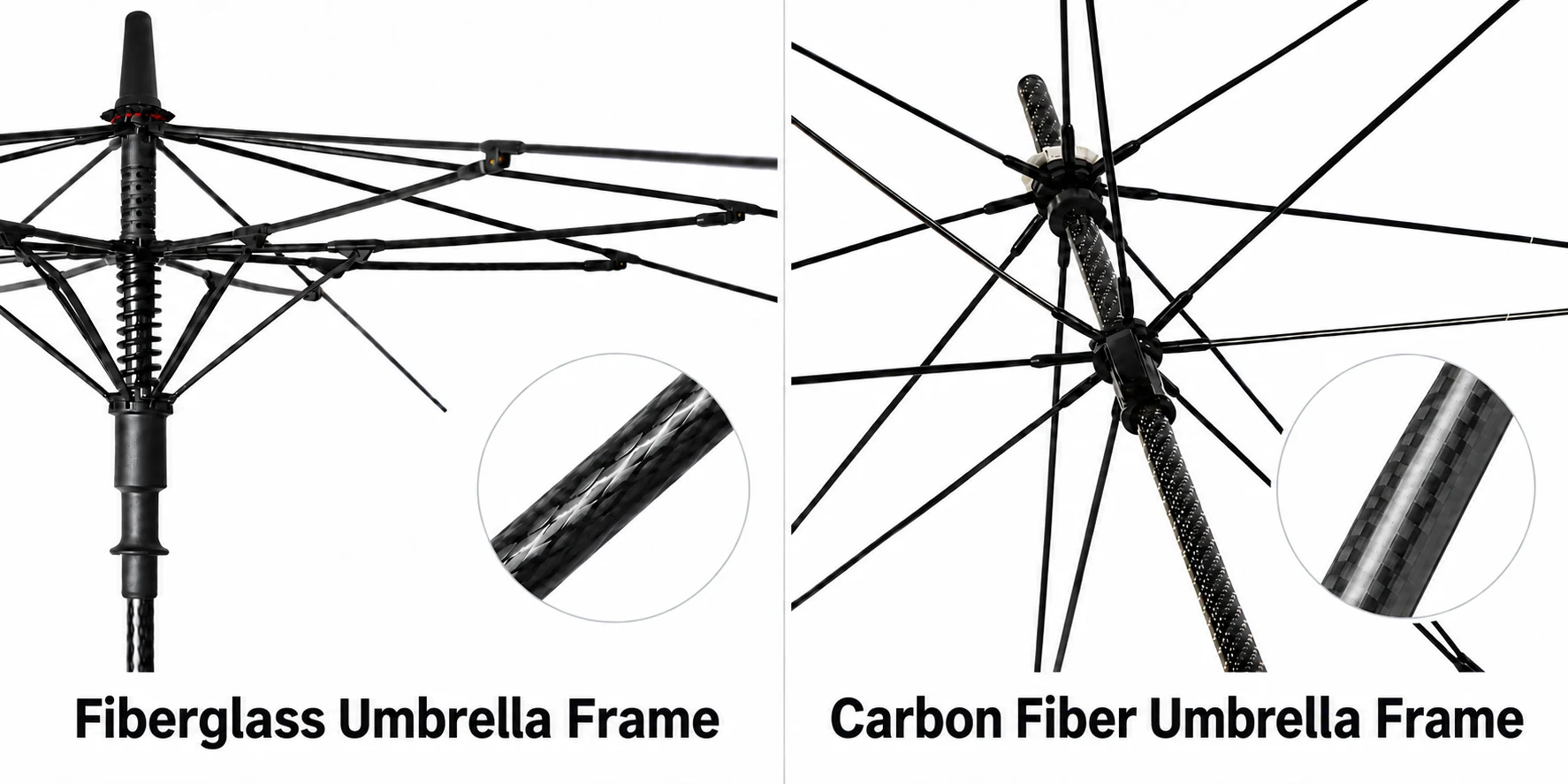
2. Fiberglass vs. carbon fiber: the practical differences
The following are general material tendencies, not a performance ranking of finished umbrellas.
| Comparison | Fiberglass option | Carbon fiber option |
|---|---|---|
| Cost | Usually lower material cost. | Usually higher material cost. |
| Weight | Suitable for many frame designs. | Can offer more scope for weight reduction. |
| Stiffness | Generally more flexible under comparable design conditions. | Generally higher stiffness relative to weight. |
| Damage | A broken part may expose small fibers. | Can suffer brittle failure or impact damage; avoid direct contact with broken edges. |
| Buying priority | Balance cost, construction and actual performance. | Check measured weight savings, construction and the extra cost. |
Composites Australia describes fiberglass’s cost advantages and carbon fiber’s low weight and stiffness, while also noting carbon fiber’s potential brittleness and impact damage. Stiffer does not mean more resistant to every kind of damage.
3. Does a stiffer carbon fiber rib guarantee a stronger, more wind-resistant umbrella?
No. Stiffness, strength and impact resistance are different properties.
- Stiffness: resistance to deformation under a load.
- Strength: the load a part can withstand before failure.
- Impact performance: how the part responds to a sudden hit.
An umbrella also depends on rib dimensions, joints, shaft, canopy and overall geometry. Carbon fiber in one part cannot, by itself, establish the wind resistance of the whole product.
If a supplier provides a wind or durability test, check four things:
- Does it cover the exact model you intend to order?
- What test method and conditions were used?
- What were the pass/fail criteria?
- Will the bulk-production configuration match the tested sample?
A material specification explains what is used. Complete-umbrella testing shows how the product performs. See our umbrella quality control process for related buying checks.
4. A damaged-handle inspection taught me to take broken parts seriously
During a recent factory visit, I inspected umbrellas damaged in transport. On one umbrella, the handle connection had broken but had not separated completely.
I was not wearing gloves. I bent the damaged area a few times with my hand to examine it. Afterwards, I felt a sharp prickling sensation that lasted several days.
This happened at the handle connection. It was not a comparative test of fiberglass and carbon fiber ribs, and the sensation alone did not identify a particular fiber or foreign body. The lesson was about inspection practice: do not bend or handle a fractured component with bare hands.
NIOSH’s fibrous-glass guidance describes risks to the skin, eyes and respiratory system from exposure, with risk depending on the amount, duration and work involved. Manufacturing dust and exposed broken edges should not be confused with normal use of an intact finished umbrella.
5. What should you do if a fiber rib or shaft breaks?
Stop using an umbrella with visible cracks, splinters, exposed fibers or a broken frame component. Contact the supplier about repair or replacement.
- Do not touch the fracture with bare hands or repeatedly flex it to identify the material.
- Keep the damaged area away from the user and other people.
- For cutting, sanding or other workshop processing, follow the material safety information and appropriate workplace precautions.
If significant prickling, redness or swelling persists, or you suspect an embedded fragment, seek medical assessment rather than repeatedly digging at the area yourself. This personal account is not a medical diagnosis.
6. How should buyers compare fiberglass and carbon fiber quotations?
In my purchasing experience, some fiberglass frame quotations were per dozen, while some carbon fiber frame quotations were per complete frame. These are examples I have encountered—not universal industry rules.
First normalize the unit: one dozen means 12. Then confirm that the configurations and scope are actually comparable.
| Check | Question to ask |
|---|---|
| Quoted item | One rib, one shaft or one complete frame? |
| Dimensions and structure | Are canopy size, fold count and rib count the same? |
| Material allocation | Which individual components or rib sections use fiberglass or carbon fiber? |
| Included parts | Are the shaft, joints and other fittings included? |
| Measured weight | Is this the weight of a component, the frame or the finished umbrella? |
| Order requirements | Are quantity, quality requirements and testing conditions equivalent? |
Two products may both be described as “carbon fiber umbrellas” while using carbon fiber in different parts. Their prices are not directly comparable until those differences are clear. Like-for-like specifications make price and weight differences meaningful.
For a fuller inquiry checklist, read how to request a custom umbrella quote.
7. Frequently asked questions
Are fiberglass ribs inferior for everyday use?
No. Judge the entire umbrella’s design, workmanship, weight and performance. A well-designed and reliably manufactured fiberglass frame can meet the intended product requirements.
Should lightweight umbrellas always use carbon fiber?
Carbon fiber is worth comparing when portability is a priority. Ask how much finished-product weight is actually saved, which components use carbon fiber and how much the price increases. A carbon fiber label is not enough.
Does a black color or woven pattern prove that a part is carbon fiber?
No. Request the material specification and a component-by-component description. Where necessary, arrange further verification rather than identifying composition from appearance.
Is “alkali-free fiberglass” simply about the quality of the sand?
No. Glass-fiber types depend on composition, not a simple sand-quality ranking. E-glass is a widely used reinforcement; other glass types address different requirements. Resin and manufacturing quality also matter. See Composites UK’s materials overview.
Is a lighter carbon fiber umbrella automatically more environmentally friendly?
No. Production energy, useful life, repair and end-of-life handling also matter. The U.S. Department of Energy’s 2015 composite-materials assessment discusses manufacturing and recycling challenges. It is general background—not a life-cycle assessment of a particular umbrella. Avoid product-level environmental claims without product-level evidence.
Conclusion: choose the complete umbrella, not just the fiber name
If budget is the priority, investigate a well-designed fiberglass option. If low carrying weight is the priority, compare the actual weight saving, quality and price of a carbon fiber option.
Ask: Which fiber? Which components? What finished weight? What verified performance? Appropriate materials, sound design and reliable manufacturing must work together.
Discuss your custom umbrella frame requirements
Send your umbrella style, size, quantity, target weight, intended use and budget to Aihua Chen at Hand in Hand Umbrella Factory. We can discuss suitable configurations and what should be confirmed before sampling and production.
Business coordination in Guangzhou · Our production base in Taoyuan Town, Heshan, Jiangmen, Guangdong · Established in 2000.
Sources and image note
This guide combines Aihua Chen’s inspection and purchasing experience with the material and occupational-health sources linked above. Those general references do not certify or test the specific umbrella frames pictured. The attached frame illustration is used for visual explanation, with English labels and separate shaft-detail insets; verify material composition against the actual product specification.