MATERIALS & PRINTING · SAMPLE DEVELOPMENT
By Aihua Chen | Hand in Hand Umbrella Factory
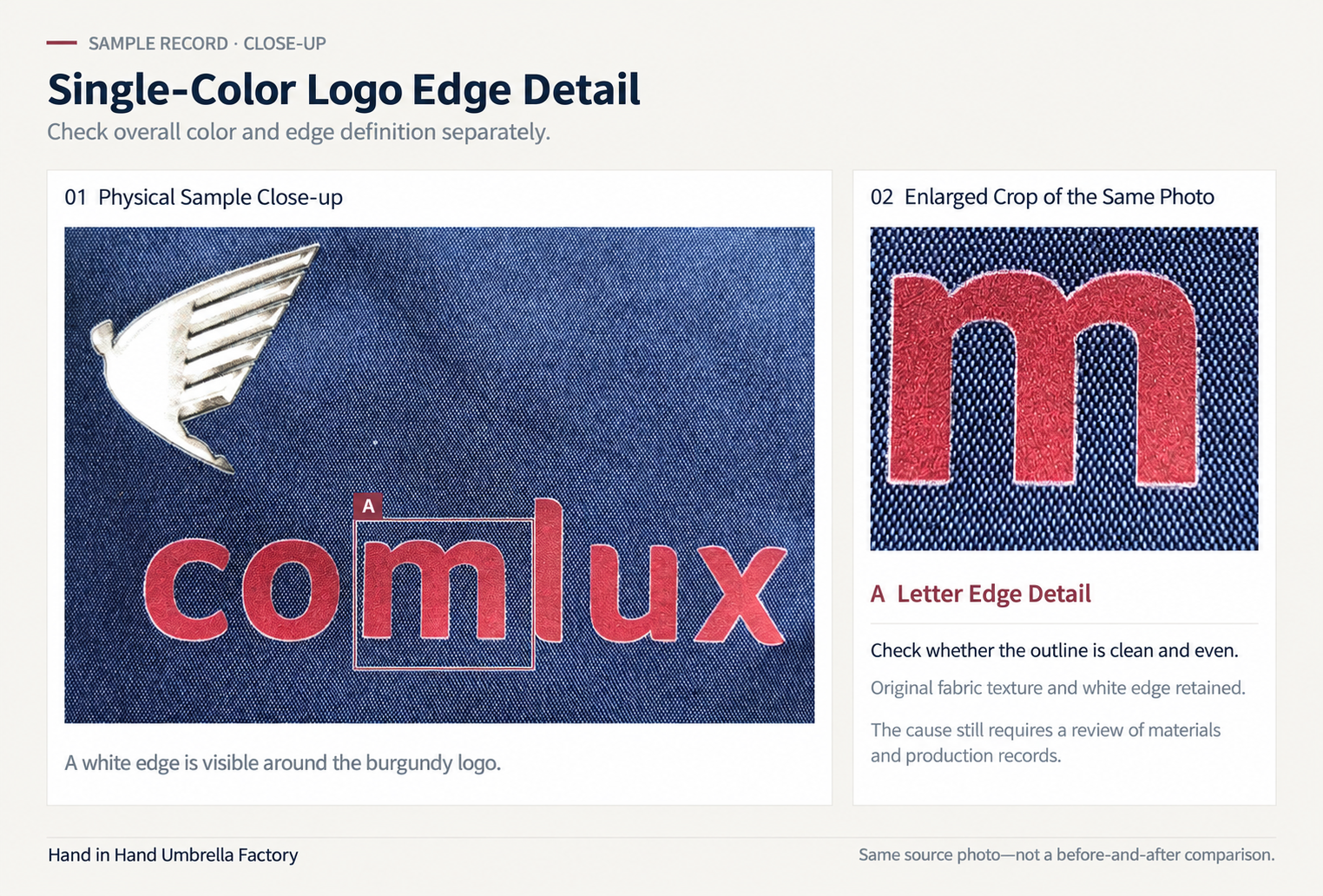
While developing an umbrella sample for a customer in Kazakhstan, we encountered two different results on the same sample: the gradient artwork achieved the intended visual effect, but the burgundy single-color logo had a visible white outline and uneven white fringes.
The customer was considering several hundred premium umbrellas. The project was still at the sampling stage when this case was recorded. The cause of the white edge had not been confirmed, and no successful corrective sample is being claimed here. The useful lesson is that sampling speed, color reproduction and edge definition need separate approval.
What did this custom umbrella project require?
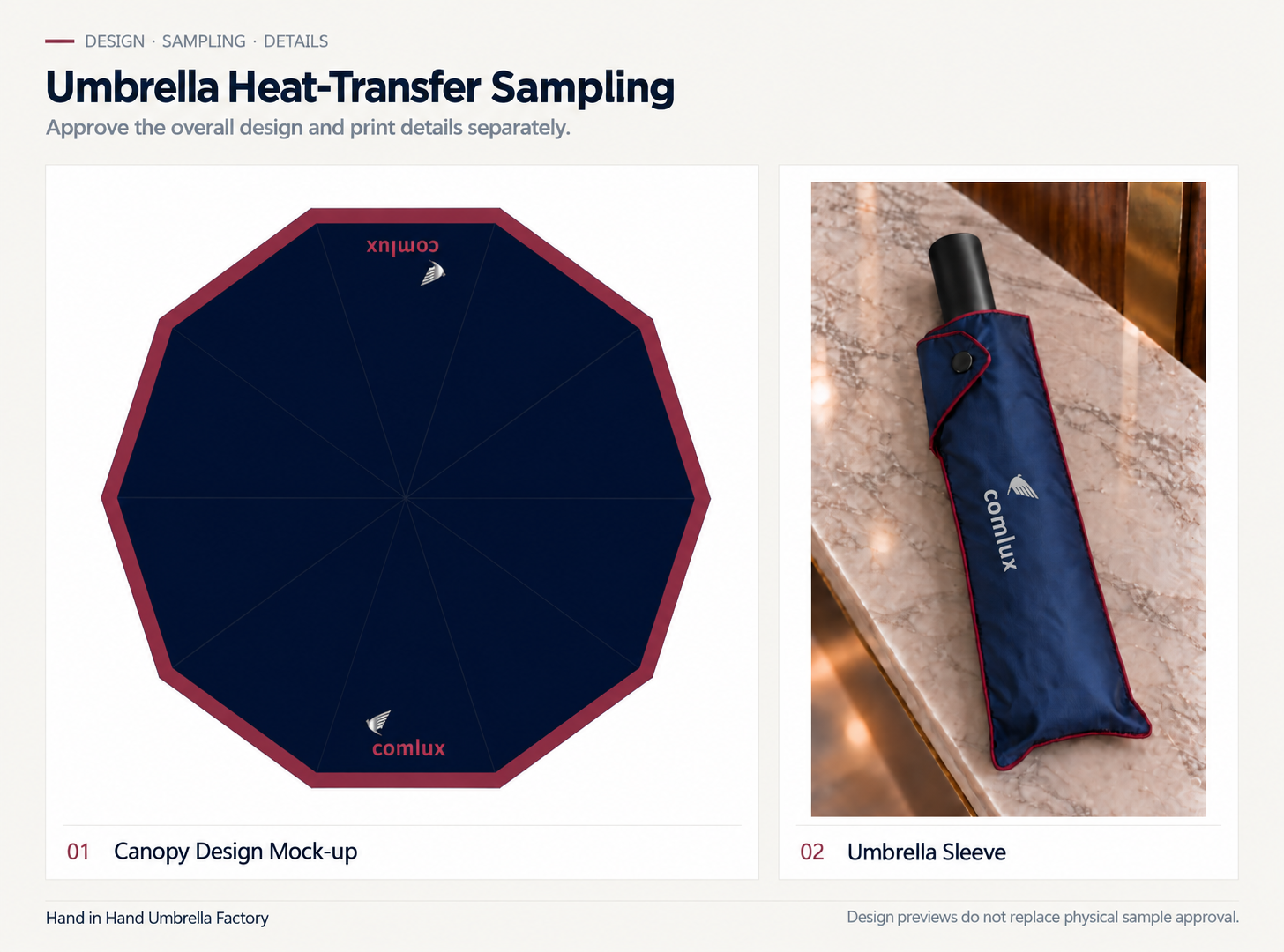
The specification combined navy canopy fabric, exterior multicolor artwork and a single-color logo, plus a logo on the sleeve. An all-over transparent-ink print was planned for the inside, creating a subtle design effect.
This article concerns the exterior heat-transfer printing. The transparent-ink interior print is a separate process and should not be confused with it.
Our factory has its own printing and heat-transfer equipment. The workflow used for this sample does not require screen preparation. When the necessary artwork and materials are ready, we can sometimes produce the printed graphic on the same day. That is not a promise to complete, approve and dispatch a whole sample umbrella within one day.
This convenience can be useful for small quantities of localized multicolor artwork. We chose it here to balance preparation time and sampling cost. Multicolor screen printing involves a different preparation process, including separations, screens and registration. The required screen count depends on the print method and separations, not simply how many colors the viewer sees. For general background, see the color sections of the STAHLS artwork guide.
Why did the gradient and the single-color logo need separate checks?
| Sample feature | Observed result | Approval implication |
|---|---|---|
| Gradient artwork | The shading and visual depth met our expectations; some areas looked silvery or metallic. | The intended visual appearance was achieved for this part of the sample. |
| Burgundy single-color logo | A white outline and uneven white fringe were visible around the logo. | Edge definition still needed adjustment and a revised sample. |
| Adhesion and folding | Further checks on the physical sample were still required. | Appearance alone did not establish long-term performance. |
The silvery appearance described here was a visual effect created by the printed shading. It does not mean that metallic ink or metal foil was used.
A regular white outline can be intentional when it is part of the approved artwork. The irregular white fringe in this case was not the result we wanted. Reproducing the main logo color was therefore not enough to approve the complete print.
Why inspect the white edge on the actual navy fabric?
On this sample, the white edge contrasted strongly with the navy background. It could be less noticeable at a distance, but close inspection of corners, fine lines and the outer contour revealed the issue more clearly.
The same white edge might be harder to see on white fabric. That would change its visibility, not necessarily solve the edge problem. Because the customer selected navy fabric, approval should use the specified navy fabric, final artwork and actual print size, rather than a substitute background that hides the detail.
How should an unwanted white edge be investigated?
The cause had not been established in this case. A photograph alone cannot reliably identify a particular material layer or processing error. Our next checks are:
- Compare with the final artwork. Confirm whether a white outline is intended. Check contours, fine lines and the final print dimensions so that designed elements can be distinguished from unwanted edging.
- Check the material combination. Record the actual canopy fabric, coating, transfer material and associated process. Confirm compatibility with the selected fabric.
- Review application records. Compare the recorded conditions with the transfer supplier’s instructions. Do not copy settings from an unrelated material.
- Make controlled comparison samples. Keep the fabric, artwork and print size consistent; record each adjustment. Inspect color, edge definition, adhesion and the condition after folding separately.
These are investigation steps, not a confirmed diagnosis or evidence that the issue has already been resolved.
STAHLS’ umbrella heat-printing guidance likewise advises selecting transfer materials suited to the particular nylon or polyester fabric and following the applicable time, temperature and pressure instructions. Use the current instructions for the actual materials in your project and validate the result on samples; this case does not establish universal settings.
Could screen printing be a better option for the solid-color logo?
It is a reasonable option to sample, but not an automatic solution. For this burgundy logo, we can compare a screen-printed sample with a revised heat-transfer sample on the same navy fabric.
| Check | Revised heat transfer | Screen-printed alternative |
|---|---|---|
| Appearance | Color, unwanted white edging, corners and fine lines | Spot-color appearance, contours and fine detail |
| Material compatibility | Transfer material with the actual fabric and coating | Ink with the actual fabric and coating |
| Use-related performance | Adhesion and condition after folding | Adhesion and condition after folding |
| Cost and lead time | Artwork, printed area, quantity and sampling requirements | Screen preparation, print colors, quantity and sampling requirements |
Different graphics on one umbrella can be assessed separately, but any combined-process proposal still needs a complete workflow review and physical sample approval. No screen-preparation charge does not automatically mean a lower total cost; a single-color logo does not automatically make screen printing the best choice.
Six checks before approving a premium umbrella sample
- Overall color: confirm gradients, shading and brand colors against the agreed requirements.
- Edge detail: inspect logo contours, corners and fine lines for unintended white outlines or ragged fringes.
- Size and placement: check the print against the approved layout, including its relationship to panels and seams.
- Fabric appearance after pressing: look for unacceptable changes within or around the printed area.
- Adhesion and folding: use the agreed inspection method and examine the print after repeated opening, closing and folding. Agree the conditions and acceptance criteria rather than assuming a universal test.
- Approval records: retain the final artwork, material specifications, approved sample and agreed inspection requirements for production reference.
Overall photographs help communicate the design; close-ups help assess edges. Adhesion and folding performance require physical checks. One type of evidence should not be used as a substitute for another.
Frequently asked questions
Does a white edge always indicate a white-ink or adhesive problem?
No. This case has not established the cause. Review the artwork, material combination and production records, then validate any proposed adjustment with a revised sample.
Why check a single-color logo separately when the gradient looks good?
The inspection priorities differ. Gradients need acceptable shading and color, while a solid-color logo also needs clean contours, corners and fine lines. Approval of one graphic does not approve the other.
Is the edge acceptable if it is difficult to see on white fabric?
Acceptance depends on the design and agreed sample requirements. A background that hides the edge does not prove that it is clean. A white-fabric trial cannot replace approval on the specified navy fabric.
Does a screen-free transfer workflow guarantee same-day sampling?
No. Our current workflow can sometimes produce the graphic on the same day when everything is ready. A complete umbrella also needs artwork approval, materials, any other printing, assembly and inspection. Confirm the complete sample lead time separately.
Can heat transfers be used on premium umbrellas?
The process name alone does not determine quality. Evaluate color, edges, adhesion and folding performance on the actual fabric, then decide whether the result meets the agreed requirements.
What should a buyer provide before sampling?
Provide final artwork, print size and location, fabric and coating information, target colors, expected quantity and timing. Include references for any strict edge-definition or special visual requirements, and confirm them on a physical sample.
Fast sampling still needs close-up inspection
This sample showed both the convenience of heat transfers for small multicolor work and a detail that still required improvement. Finding that issue before bulk production is part of the purpose of sampling—not proof that the investigation is complete.
Hand in Hand Umbrella Factory supports buyers in comparing practical production options. Our business coordination is in Guangzhou, and our production base is in Taoyuan Town, Heshan, Jiangmen, Guangdong.
For related decisions, read our umbrella printing-method comparison, color-bleeding treatment guide and fabric color-sampling guide. Color bleeding and white edging are different observations; these guides should not be treated as a diagnosis of the same defect.
Send your artwork, fabric requirements and expected quantity to discuss a sample plan. Choose the bulk-production method after the physical sample has been checked and approved.